
News to use
USS Abraham Lincoln to shift home port to Bremerton
from Commander Naval Air Forces
SAN DIEGO - Nimitz-class aircraft carrier USS Abraham Lincoln (CVN 72) will shift its home port from San Diego to Bremerton, Wash., later this year to complete a long-planned maintenance availability. The relocation will be executed as a permanent change of station (PCS) for the crew and family members.
This shift comes after returning from a 10-month deployment to the U.S. 3rd, 5th, and 7th Fleet areas of operations in support of U.S. national security objectives.
Abraham Lincoln arrived in San Diego in January 2020, serving as the flagship for Carrier Strike Group (CSG) 3. The carrier repeatedly demonstrated unmatched multi-theater combat lethality and safeguarded critical sea lanes across the Indo-Pacific and Middle Eastern theaters.
Throughout the home port shift process, Abraham Lincoln Sailors and their families will have access to resources which will prepare for the transition.
Home port shifts are part of the Navy’s continued commitment to the strategic dispersal of ships.
DOT, DoW, DHS join forces to protect southern border airspace
The U.S. Department of Transportation, Department of War and Department of Homeland Security announced Oct. 16 a new, coordinated effort to strengthen airspace security along the southern U.S. border through a temporary flight restriction for drones. The TFR will bar any unauthorized drone activity up to 400 feet above ground level and extend one nautical mile north of the U.S.-Mexico border.
Theodore Roosevelt participates in Keen Sword
Aircraft carrier USS Theodore Roosevelt, flagship of Carrier Strike Group (CSG) 9, cruiser USS Chosin and destroyer USS Decatur arrived at Fleet Activities Yokosuka, Oct. 16 , ahead of exercise Keen Sword.
“Our crew is honored to visit Yokosuka and experience the rich culture and hospitality of Japan,” said Capt. Will Mathis, commanding officer of Theodore Roosevelt. “Port visits like this are vital for crew morale and mission readiness, allowing our Sailors to rest, recharge, and prepare to operate seamlessly alongside our allies during exercise Keen Sword.”
While in Yokosuka, CSG 9 will engage in professional exchanges with counterparts from the Japan Maritime Self-Defense Force (JMSDF) to align tactical procedures and strengthen bilateral integration alongside preparations for Keen Sword 2027. Keen Sword is a routine, biennial bilateral field training exercise designed to increase readiness and interoperability between the JMSDF and U.S. military forces.
Navy establishes Seabee Training and Evaluation Unit (STEU) 1 to drive Pacific Force readiness
by PO1 Matthew Dickinson,
Naval Construction Group ONE
The Navy officially commissioned Seabee Training and Evaluation Unit (STEU) 1 during a ceremony on board Naval Base Ventura County, Port Hueneme,Oct. 16.
STEU 1, which was administratively established May 1, 2026, by the Chief of Naval Operations, serves as the premier training and evaluation authority for all Pacific Fleet Naval Construction Force commands organized under Naval Construction Group 1.
The stand-up of STEU 1 represents a strategic realignment under Navy Force Design to optimize readiness, formalize pre-deployment qualifications and preserve critical expeditionary engineering billets across the Pacific theater.
Capt. Andrew Litteral, commodore, NCG 1, served as the presiding officer and emphasized the strategic importance of the new command.
“In today’s contested global security environment, readiness is our strongest deterrent and our decisive edge if deterrence fails,” Litteral said. “When our Seabee Battalions and Underwater Construction Teams deploy downrange, they cannot afford a learning curve. They operate in austere, distributed, and expeditionary environments where the margins for error are nonexistent. That is precisely why STEU 1 is standing up today.”
Lt. Cmdr. Gerard Ramoutar read his official orders and formally assumed command as the commanding officer of STEU 1. The unit’s newly designed colors, featuring heraldry designed by Seabee Master Chief Ryan Sweet, were officially unfurled, followed by the setting of the command’s first official watch.
“Today marks a pivotal milestone for our Pacific Seabees,” Ramoutar said upon assuming command. “Our mandate is clear: build and sustain combat-ready units of action that can execute expeditionary logistics, airfield damage repair and tactical defense under the most demanding conditions. STEU 1 stands ready to deliver that training and ensure our forces are certified to win.”
Under its approved mission, STEU 1 develops and delivers advanced combat and technical skill sets to NCF units, validating their capabilities throughout the Optimized Fleet Response Plan cycle prior to deployment across the Indo-Pacific area of operations.
Youth Programs partners with United Through Reading to keep military families connected through storytime
Navy Child and Youth Programs (CYP) has launched an enterprise-wide partnership with the nonprofit United Through Reading (UTR) to help military families maintain strong emotional connections during periods of separation. The initiative, titled “Read, Record, Connect: Keeping Military Families Connected Through Storytime,” will provide books, literacy resources, recording opportunities, and digital tools to Navy installations and military households. The program addresses the challenges families face during deployments, underways, extended duty shifts, temporary assignments, and relocations by allowing children to see and hear their parents reading familiar stories, supporting family bonds, emotional well-being, and early childhood literacy.
Beginning in fall 2026, the eight-month initiative will distribute 24,850 children’s and youth books, 165,000 bookmarks, and 100,000 early literacy guides designed for families with infants and children ages five and younger. The partnership will also provide 65 specialized in-person recording events, including 41 sessions staffed by United Through Reading and 24 events using Mobile Story Stations. Recording opportunities will focus on major fleet concentration areas, including the Pacific Northwest, San Diego, Hampton Roads, Naval District Washington, and Florida. Resources will be distributed in phases from October 2026 through April 2027, with shipments and materials timed around seasonal reading activities and the Month of the Military Child.
Service members will be able to record themselves reading books through the United Through Reading smartphone app, then share the videos with a co-parent or caregiver so children can watch and follow along with a printed copy of the story. Families will also have access to local and command story stations and in-person recording events. Vice Adm. Brad Collins, Commander of Navy Installations Command, said the partnership reflects the Navy’s commitment to improving Quality of Service and strengthening family resilience. By making shared reading possible even when Sailors are thousands of miles from home, the initiative aims to support children’s development, maintain meaningful parent-child relationships, and help Navy families remain connected throughout the demands of military service.
USS Theodore Roosevelt arrives in Yokosuka
Nimitz-class aircraft carrier USS Theodore Roosevelt (CVN 71), flagship of Carrier Strike Group (CSG) 9, Ticonderoga-class guided-missile cruiser USS Chosin (CG 65) and Arleigh Burke-class guided-missile destroyer USS Decatur (DDG 73) arrived at Commander, Fleet Activities Yokosuka, Oct. 16, 2026, ahead of exercise Keen Sword.
The visit provides the ship’s crew an opportunity to conduct routine maintenance and resupply, while preparing the strike group to participate in a premier joint-bilateral field training exercise.
"Our crew is honored to visit Yokosuka and experience the rich culture and hospitality of Japan," said Capt. Will Mathis, commanding officer of Theodore Roosevelt. "Port visits like this are vital for crew morale and mission readiness, allowing our Sailors to rest, recharge, and prepare to operate seamlessly alongside our allies during exercise Keen Sword."
While in Yokosuka, Carrier Strike Group (CSG) 9 will engage in professional exchanges with counterparts from the Japan Maritime Self-Defense Force (JMSDF) to align tactical procedures and strengthen bilateral integration alongside preparations for Keen Sword 2027. Keen Sword is a routine, biennial bilateral field training exercise designed to increase readiness and interoperability between the Japan Self-Defense Forces (JSDF) and U.S. military forces.
Philippine, U.S. Forces conduct Maritime Cooperative Activity
From U.S. 7th Fleet Public Affairs
The Armed Forces of the Philippines and U.S. Navy conducted a Maritime Cooperative Activity (MCA) within the Philippine Exclusive Economic Zone, Oct. 14, 2026. This activity continues to showcase our demonstrated, collective commitment to strengthening regional and international cooperation in support of a free and open Indo-Pacific.
This exercise expanded capabilities by incorporating and refining shared specialized procedures and maritime doctrines. The exercise focused on tactical interoperability, maritime domain awareness, and included a group sail to build at-sea proficiency. This iteration complements the work developed and refined in previous MCAs.
MCAs are conducted in a manner consistent with international law and with due regard to the safety, navigational rights, and freedoms of all nations.
Participating units included: one AW159 Wildcat helicopter and one C208 Caravan from the Philippine Air Force; Teresa Magbanua-class patrol vessel BRP Melchora Aquino (MRRV 9702) from the Philippine Coast Guard; Miguel Malvar-class guided missile frigate BRP Miguel Malvar (FFG 06) from the Philippine Navy; and Avenger-class mine countermeasures ship USS Warrior (MCM 10) from the U.S. Navy.
USS John Basilone arrives at new homeport in Rota, Spain
From U.S. 6th Fleet Public Affairs
Arleigh Burke-class guided-missile destroyer USS John Basilone (DDG 122) arrived at its new homeport of Naval Station Rota, Spain, Oct. 14, joining forward-deployed U.S. naval forces operating in Europe.
John Basilone joins units assigned to Commander, Task Force 65 and Destroyer Squadron 60, supporting regional maritime security operations and routine training opportunities alongside NATO Allies and regional partners.
Commissioned in late 2024, John Basilone is a multi-mission guided-missile destroyer capable of conducting air defense, anti-submarine warfare, and surface warfare operations. The ship officially transferred homeports from Naval Station Mayport, Florida.
The ship honors Marine Corps Gunnery Sgt. John Basilone, who received the Medal of Honor for his actions at the Battle of Guadalcanal in 1942 and was posthumously awarded the Navy Cross for bravery at the Battle of Iwo Jima in 1945. Basilone was the only enlisted Marine in World War II to receive both decorations.
Navy flies drones without GPS, lands autonomously on moving ships
The Naval Air Warfare Center Aircraft Division (NAWCAD) at Patuxent River, Maryland, has successfully demonstrated an unmanned aircraft system (UAS) capable of completing missions and autonomously landing on a moving Navy ship without GPS or direct pilot control. The technology uses commercial-standard cameras, motion sensors, and onboard electronics paired with advanced guidance, navigation, and control software developed by NAWCAD’s Maritime Autonomous Guidance-Navigation-Control Intelligent Coupled Systems Lab. The system identifies a ship’s shape and visual reference points to guide the aircraft, while algorithms predict the movement of the ship’s pitching deck to enable a safe landing. According to NAWCAD Commander Rear Adm. Todd Evans, the capability could provide a significant advantage in contested environments where adversaries jam satellite navigation and communications.
The software-based approach could reduce the Navy’s reliance on expensive radar systems, specialized recovery equipment, and costly ship modifications traditionally required for unmanned aircraft recovery. Designed to work with a range of onboard computer hardware, the technology could be adapted to platforms ranging from small tactical quadcopters to larger combat-class aircraft through software upgrades. Following the successful initial demonstrations, NAWCAD is preparing the capability for operational testing on fleet platforms and exploring its integration into tactical resupply drones and other unmanned aviation programs. The effort is being advanced in coordination with the Navy’s Small Tactical Unmanned Aircraft Systems program office, the Collaborative Combat Aircraft program, and the Defense Advanced Research Projects Agency’s EVADE project. Funded by the Naval Innovative Science and Engineering Program and the Office of Naval Research, the initiative aims to expand the Navy’s ability to operate unmanned aircraft in GPS-denied environments while improving operational flexibility and reducing integration costs.
U.S. Navy and AUKUS partners launch landmark Maritime Big Play Pacific demonstration
SAN DIEGO — The U.S. Navy, alongside international military and research partners from Australia and the United Kingdom, recently initiated active testing for the AUKUS Pillar II Maritime Big Play Pacific (MBP-P) demonstration in the Southern California (SOCAL) operating area.
Sponsored by the Office of the Under Secretary of War for Research and Engineering, Critical Technologies (OUSW(R&E) CT) and hosted by Naval Information Warfare Center (NIWC) Pacific, U.S. Pacific Fleet as well as the U.S. Marine Corps, this experimentation event is expected to achieve milestones in integrating mature robotics and autonomous systems within AUKUS coalition maritime operations. Running from October 05 - 25, 2026, the event will showcase more than 40 government and industry technologies from across all three partner nations, including multi-domain autonomous, crewed, and uncrewed systems (UxS).
The MBP-P demonstration builds off three years of intensive trilateral collaboration, advancing common command and control solutions for generating overwhelming combat mass, as well as delivering secure ‘stratosphere to seabed’ communications that enable AUKUS to act in coordination across the entire maritime domain. The event will feature live-fire operational vignettes focused on increasing mission effect and delivering force multipliers during strike operations, contested resupply, and undersea warfare.
"This demonstration represents a significant step forward as partners to integrate and fight together in future conflicts,” said Gerry Tighe, U.S. Lead for AUKUS Maritime Big Play. "This effort strives for seamless integration of autonomous systems with our conventional maritime fleet, and further as part of a greater combined partner force.”
“We’ve brought together cutting-edge systems from across our shared industrial base, put those solutions into the hands of AUKUS Warfighters so they can train together, and removed the technical barriers for integrating those advanced capabilities into no-kidding operations,” he said. “Maritime Big Play underscores the shared commitment of Australia, the United Kingdom, and the United States to maintaining security, stability, and prosperity in the Indo-Pacific region."
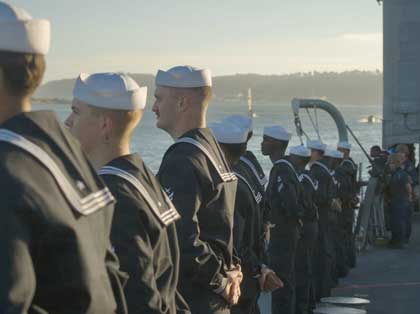
U.S. Navy Sailors assigned to Ticonderoga-class guided-missile cruiser USS Robert Smalls (CG 62), man the starboard rails as the ship arrives at Naval Base San Diego, Oct. 10, 2026. Robert Smalls recently completed a homeport shift from Yokosuka, Japan, to San Diego following a seven-month deployment supporting U.S. 7th Fleet operations, including operations with two carrier strike groups in the Pacific. U.S. Navy photo by Lt. j.g. Nicholas Clark.
USS Robert Smalls returns to new homeport San Diego after a 7-month deployment
From Commander, U.S. 3rd Fleet Public Affairs
SAN DIEGO — Ticonderoga-class guided-missile cruiser USS Robert Smalls (CG 62) arrived at its new homeport of Naval Base San Diego, following a 7-month deployment supporting U.S. 7th Fleet operations, including two carrier strike groups in the Pacific, Oct. 9.
Ticonderoga-class guided-missile cruiser USS Robert Smalls (CG 62) arrived at its new homeport of Naval Base San Diego, following a 7-month deployment supporting U.S. 7th Fleet operations, including two carrier strike groups in the Pacific, Oct. 9.
After departing Yokosuka, Japan, on March 9, 2026, Robert Smalls, along with an air wing detachment from Helicopter Maritime Strike Squadron (HSM) 51, conducted operations to strengthen regional partnerships and demonstrate the U.S. Navy’s commitment to achieving peace through strength in the U.S. 7th Fleet.
Robert Smalls supported the Abraham Lincoln Carrier Strike Group, the George Washington Carrier Strike Group, and the Tripoli Amphibious Ready Group/31st Marine Expeditionary Unit, as well as partners and allies. The ship served in multiple critical command and control roles for both the George Washington and Abraham Lincoln Strike Groups, including Alternate Composite Warfare Commander, Air and Missile Defense Commander, and Aircraft Control Unit.
"The crew of Robert Smalls performed with distinction throughout this deployment and homeport shift," said Capt. Francisco X. Garza, commanding officer of Robert Smalls. "Whether serving as the sole escort for a carrier during CVN sea trials, workups and certification, responding to a shipmate in need, or conducting complex air defense operations in the South China Sea, our Sailors consistently demonstrated the professionalism and tactical excellence that defines Forward-Deployed Naval Forces. I am incredibly proud of what this team accomplished."
While underway, Robert Smalls made a historic return to Da Nang, Vietnam, where the ship visit served to underscore the two nations’ commitment to a Comprehensive Strategic Partnership that spans political, security, economic and people-to-people ties.
Robert Smalls steamed more than 40,000 nautical miles across U.S. 3rd, and U.S. 7th Fleets; and transited through five strategic waterways. Robert Smalls integrated three Australian warships and one Japanese warship into strike group battle rhythm, strengthening maritime interoperability with allies in the region. Robert Smalls completed 14 successful underway replenishments, including two with an Australian oiler and one with a U.S. commercial tanker.
This homecoming marks Robert Smalls' transition from Yokosuka to San Diego as part of a scheduled rotation of forces to comply with federal law requiring that Forward-Deployed Naval Forces ships not exceed 10 years forward deployed. Arleigh Burke-class guided-missile destroyer USS Mustin (DDG 89) arrived in Japan, March 2026, to replace Robert Smalls.
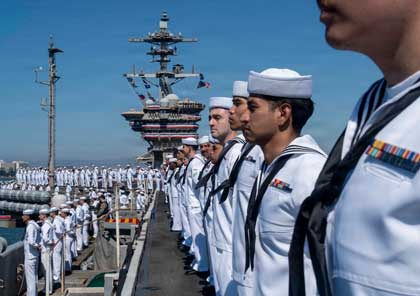
Sailors man the rails as Nimitz-class aircraft carrier USS Abraham Lincoln returns to its homeport of San Diego following 10 months of operations in the U.S. 5th and 7th Fleet areas of operations. Photo by Petty Officer 3rd Class Angel Campbell,
USS Abraham Lincoln (CVN 72).
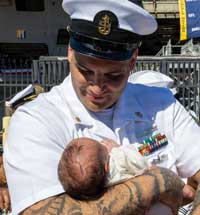 |
WELCOME HOME
U.S. Navy Sailors reunite with family members and their children as the Nimitz-class aircraft carrier USS Abraham Lincoln (CVN 72), returns from a deployment at Naval Station North Island, Calif., Oct. 8, 2026. Photo by Seaman Spencer Price, USS Abraham Lincoln (CVN 72) |
USS Abraham Lincoln returns to San Diego after 10-month deployment
by Chief Petty Officer
Joseph Montemarano, USS Abraham Lincoln
Aircraft carrier USS Abraham Lincoln departed its home port Nov. 21, 2025. In the 321 days since casting off lines from San Diego, the ship and its crew sailed across the Pacific Ocean, through the San Bernardino Strait, Surigao Strait and Strait of Malacca, and into the South China Sea, Indian Ocean and Arabian Sea.
The ship steamed more than 93,000 nautical miles, conducted 72 replenishments-at-sea and received more than 20.5 million gallons of aviation fuel during the operations. Lincoln’s crew also supported more than 13,000 aviation sorties from Carrier Air Wing 9 aircraft, totaling 28,500 flight hours.
“[The] USS Abraham Lincoln and the entire carrier strike group team set a new standard of excellence through their extraordinary conduct during this historic deployment,” said Rear Adm. Robert Loughran, Carrier Strike Group 3 commander. “I am incredibly proud of each and every sailor, Marine and member of this team for what they have accomplished under the most demanding conditions. Their professionalism, resilience and combat effectiveness have been unmatched. We now look forward with great excitement to their well-earned reunion with family and loved ones.”
Read more....
FRCSW hosts DoW leaders
by Michael A Furlano, Fleet Readiness Center Southwest
Department of War leaders recently visited Fleet Readiness Center Southwest (FRCSW) for an in depth look at the command’s mission, capabilities, and continued success supporting the Warfighter.
Michael Powers, Deputy Undersecretary of War – Comptroller; Thomas Harker, Deputy Financial Officer, Undersecretary of War – Comptroller; and John Grabenstein, SES, NAVAIR Director of Product Support, all received a command overview highlighting FRCSW’s production and financial accomplishments, including a remarkable record of meeting or surpassing aircraft production goals for 10 consecutive years. The brief underscored the command’s commitment to disciplined execution, responsible stewardship of resources, and delivering combat ready aircraft and components to the Fleet.
Following the brief, the delegation received a tour of FRCSW’s F/A-18, F-16, V-22, Manufacturing and Components programs from Capt. Jason Martinson, FRCSW executive officer, and David Kelly, FRCSW production director). Visitors gained firsthand insight into the skilled workforce, advanced capabilities, and complex processes that keep critical aviation assets ready and relevant.
From the production floor to financial stewardship, FRCSW continues to demonstrate what is possible when mission focused personnel, resources, and expertise come together in support of Naval Aviation.
San Diego-based aircraft carrier
USS Theodore Roosevelt deploys
The aircraft carrier USS Theodore Roosevelt (CVN-71) left San Diego on Sunday, Sept. 27, for a possibly extended Middle East deployment,
In an Aug. 26 report by USNI News about the Roosevelt’s deployment, the carrier’s 5,000-strong crew is expected to head to Central Command’s area of responsibility, where the aircraft carrier will relieve the USS George Washington..
According to a story in Task and Purpose, the Roosevelt sailors and their families were told before the deployment to prepare for about eight months away, with the possibility of an extension as the Navy continues to contend with extended carrier deployments driven by operations in the Middle East.
Vice Adm. Brad Collins Takes Command of CNIC, Vows Focus on 'Fleet, Fighter, and Family'
WASHINGTON, D.C. — Vice Adm. Brad Collins officially assumed command of Commander, Navy Installations Command (CNIC) from Vice Adm. Scott Gray during a change of command ceremony at the Washington Navy Yard on September 24, 2026. Vice Chief of Naval Operations Adm. James Kilby presided over the event, highlighting the vital role shore installations play as warfighting platforms where the Navy builds and supports its most important weapon system—its Sailors. Collins, who previously served as the CNIC Chief of Staff and commanded multiple Navy regions, expressed his commitment to maintaining enterprise continuity and delivering responsive, practical support to the fleet, the fighter, and military families.The ceremony marked the conclusion of a highly impactful three-year tour for Gray, who is transitioning to the Pentagon to serve as the Deputy Chief of Naval Operations for Navy Sustainment. Under Gray's leadership, CNIC underwent extensive modernization across its $9.5 billion annual infrastructure portfolio, establishing itself as the Shore Type Commander and driving significant Quality of Service upgrades. His tenure delivered tangible improvements to living standards, including free Wi-Fi in barracks and a massive 500 percent expansion of the Military Childcare in Your Neighborhood-PLUS program, which successfully reduced the Navy’s overall childcare waitlist by nearly 5,000 children.
New command stands up: Navy launches Robotic and Autonomous Systems Warfighting Center
The U.S. Navy officially established the Robotic and Autonomous Systems Warfighting Development Center (RASWDC) at Joint Expeditionary Base Little Creek-Fort Story to speed up how sailors use unmanned tech at sea. Operating under U.S. Fleet Forces Command, this new hub unites autonomous efforts across air, surface, and undersea domains. It gives the fleet specialized training, new combat rules, and the tools needed to win high-end fights.
The center works closely with the Direct Reporting Portfolio Manager for Robotic and Autonomous Systems (DRPM RAS) to connect tech builders with active sailors. While DRPM RAS handles buying gear and setting rules, RASWDC focuses on real-world use. This direct link lets the Navy test gear, learn fast, and send performance data right back to developers to make future systems better.
The KC-130J Powers Modern Island-Hopping in the Indo-Pacific
The 3d Marine Aircraft Wing relies on the KC-130J Super Hercules as a vital logistics hub during Operation Slingshot in the vast Indo-Pacific. This proof-of-concept strategy uses the heavy cargo aircraft to leapfrog ahead of F-35B Lightning II fighters, establishing forward refueling and re-arming points at remote, undeveloped airfields. By carrying essential gear, fuel, and maintainers across thousands of miles of ocean, the KC-130J gives pilots the reach required to operate without external strategic tankers.
Tracing its roots back to the Korean War and the 1968 siege of Khe Sanh, the C-130 platform has long served as the logistical backbone of military aviation. During past conflicts in Vietnam and Operation Desert Storm, these aircraft repeatedly proved their worth by delivering massive tonnages of supplies and providing critical aerial refueling. Operation Slingshot updates this historic island-hopping capability for today's modern battlefield, enabling tactical fighter jets to strike fast and move even faster across 4,000 nautical miles of ocean.
Executing these complex, self-supported missions requires precise coordination and skill from the entire flight crew. Pilots navigate long-range over-water routes and land the heavy aircraft onto austere airstrips, while loadmasters manage high-stress ground refueling operations in the cargo hold. Ultimately, the KC-130J remains an indispensable workhorse that extends the lethal range of Marine Corps aviation into the future
Hegseth Addresses Team Who Built Sea Drone Used to Rescue Downed Apache Crew
by C. Todd Lopez | Sept. 18, 2026
In early June, an Army AH-64 Apache helicopter patrolling regional waters went down off the coast of Oman, leaving two crew members in need of rescue. An autonomous surface vessel — a U.S. Navy Corsair operated by the 5th Fleet's Task Force 59 — rescued the soldiers.
The autonomous seafaring vessel — manufactured by Texas-based Saronic — picked up the crew members and transported them to another location on the water where they were then hoisted into a helicopter for further transport.
Saronic builds a variety of autonomous vehicles for the U.S. military and Secretary of War Pete Hegseth visited the company and workforce to see how they make hardware that enables the joint force. He thanked them for the work they are doing now and will do in the future as part of the Arsenal of Freedom tour.
"What Saronic demonstrates is the future of American naval power, delivering over 300 combat-proven Corsairs; rapidly fueling the 52-foot Mirage and scaling blue water reach with the 180-foot Marauder, all built in under a year," he said. "In our building, we're used to timelines of seven, eight years. One year is not a thing ... I came to see and it's real. That's the kind of scale and speed that our department needs. The kind of competition our building needs, the bureaucracy needs to realize that it can be done."
Navy aligns Public Works under installation commanding officers
WASHINGTON – The Navy announced Sept. 22, the completion of the transfer of public works maintenance teams from Naval Facilities Engineering Systems Command (NAVFAC) to Commander, Navy Installations Command (CNIC), placing approximately 10,000 civilian and military personnel under the direct authority of base commanding officers.
“This move is all about giving our base commanders the tools and authority they need to get the job done,” said Vice Adm. Scott Gray, Commander, Navy Installations Command. “By putting maintenance teams directly under local command, we can make quicker decisions, prioritize repairs, and keep our bases running smoothly. I am proud to welcome public works professionals to the CNIC team as we work together to support our Sailors, families, and fleet operations.”
The Navy completed the first stage of this realignment in February 2026, transferring approximately 2,000 installation personnel providing facilities management and environmental functions services. The second stage of the realignment completed Sept. 20, 2026, and includes approximately 8,000 installation public works and mission support personnel. The administrative transfer of host nation and U.S. civilian service personnel in Japan will occur Nov. 1, 2026, in accordance with country-specific personnel transfer requirements.
While CNIC will now run everyday base maintenance, NAVFAC will provide infrastructure construction, engineering, and contracting capabilities that enable Navy and Marine Corps lethality.
“NAVFAC and CNIC worked closely together to set the conditions for a seamless transition of public works functions and ensure continuous support to the fleet,” said Rear Adm. Jeff Kilian, Commander, Naval Facilities Engineering Systems Command. “This realignment strengthens NAVFAC’s ability to drive acquisition reform and accelerate delivery of infrastructure solutions critical to Navy and Marine Corps warfighting readiness.”
Meritocracy at Center of Military Service, Hegseth Tells Cadets at Texas A&M
by C. Todd Lopez | Sept. 19, 2026
At Texas A&M University in College Station, Texas, Secretary of War Pete Hegseth told future officers that the U.S. military they will enter places a premium on meritocracy, and that once they put on their uniforms, they will march into formations that value them only for what they bring to the fight.
"Under the leadership of our commander in chief, President Donald J. Trump, our doctrine is clear: America first and peace through strength," Hegseth said. "And we achieve it in three distinct ways: reviving the warrior ethos, rebuilding our military and reestablishing deterrence here at home and across the globe."
The secretary said that he knew restoring the warrior ethos also meant establishing a military centered on meritocracy rather than non-merit factors.
Read the full message....
Guidance issued: Implementing testosterone ceficiency screenings for male service members
by C. Todd Lopez, Pentagon News | Sept. 17, 2026
The War Department released clinical practice guidelines today for medical professionals across the force on how to evaluate and treat potential testosterone deficiencies in male warfighters.
In July, Secretary of War Pete Hegseth's memorandum, "Health and Human Performance Optimization to Enhance Military Readiness," directed screening of service members age 30 and older for testosterone deficiency during annual periodic health assessments.
The effort, Hegseth said, is meant to ensure that service members remain at peak performance levels throughout their careers.
Read more on the story....
 Air Force Capt. Hanna Born, an instructor pilot assigned to the 23rd Flying Training Squadron, carries the flag of honor during the 2025 Army Ten-Miler in Washington, Oct. 12, 2025. The flag is inscribed with the names of all 2,977 victims of the Sept. 11, 2001, terrorist attacks. The race is part of Born's personal commitment to run 2,977 miles: one mile for every life lost, to ensure the next generation continues to honor the nation's promise to never forget.
Photo by Air Force Airman 1st Class Nelvis Sera
Air Force Capt. Hanna Born, an instructor pilot assigned to the 23rd Flying Training Squadron, carries the flag of honor during the 2025 Army Ten-Miler in Washington, Oct. 12, 2025. The flag is inscribed with the names of all 2,977 victims of the Sept. 11, 2001, terrorist attacks. The race is part of Born's personal commitment to run 2,977 miles: one mile for every life lost, to ensure the next generation continues to honor the nation's promise to never forget.
Photo by Air Force Airman 1st Class Nelvis Sera
Airman runs 2,977 miles honoring 9/11 victims
by Airman 1st Class Nelvis Sera, Air University Public Affairs
At Fort Rucker, Alabama, Air Force Capt. Hanna Born trains the next generation of rotary-wing aviators in the TH-1H training helicopter. Outside the cockpit, she is leading a personal mission to honor the victims of the Sept. 11, 2001, terrorist attacks by running 2,977 miles — one mile for each person killed that day.
Born, an instructor pilot assigned to the 23rd Flying Training Squadron, launched the effort on Sept. 11, 2025, with the goal of carrying their stories forward to the 25th anniversary of the attacks.
Her connection to 9/11 is personal. She and her younger sister were inside the Pentagon Child Development Center when American Airlines Flight 77 struck the building.
"We were safely evacuated and reunited with our family, which is an outcome thousands of others never received," Born said. "We've always felt a deep obligation to honor the lives and families who were not as fortunate."
With each mile, she shares a victim's name and story on social media, ensuring the lives behind the numbers are remembered.
"I want to make sure people hear their names," Born said. "Not just the number; the people."

Department recognizes Suicide Prevention Programs for supporting warfighters
by Robert Hammer, Office of the Assistant Secretary of War for Health Affairs
The War Department recognized unique and innovative suicide prevention programs during a ceremony in the Pentagon's Hall of Heroes, Sept. 2.
The 11 department and two Coast Guard programs were recognized for building partnerships, equipping leaders and peers, connecting people with resources, and creating environments in which service members and families could more readily seek support.
"It is not just what they did during the last Suicide Prevention Month," said Alicia Matteson, Defense Suicide Prevention Office acting director. "They represent sustained efforts, informed by data, informed by the needs of their particular communities that they are serving."
Keith Bass, assistant secretary of war for health affairs, praised each of the honorees before handing out the awards.
"Today, we honor outstanding individuals for their efforts. I was just absolutely in awe of the creativity and the passion," Bass said. "Thank you on behalf of the Military Health System."
Joining Bass and Matteson during the annual event were Tim Hoyt, Defense Health Agency chief mental health officer, and Coast Guard Rear Adm. Shane Steiner, Coast Guard deputy assistant commandant for workforce and family services.
September may be Suicide Prevention Month, Hoyt noted, "but the individuals and commands we recognize today did not limit their work to a single month, event or campaign. They invested in suicide prevention throughout the year."
Hoyt added that celebrating these efforts today conveys to the force that the department values a multilayered approach to suicide prevention, which includes:
Leaders who know and care for their people.
Commands who act before concerns become a crisis.
Programs that make support easier to access.
Teams that strengthen connection and belonging.
The recognized programs represent a vital part in fostering that sense of support and connection in military communities, the speakers underscored.
Bass said when someone seeks care in a military hospital or clinic, "we will wrap our arms around that individual. We're going to take care of them and we're going to take care of our families. We have to continue to push this awareness. Nobody's alone. We do this as a team to take care of our folks."
During the ceremony, leaders emphasized that hope resounded throughout each team's efforts to prevent suicide.
"Hope is a belief that things will get better. But it's more than that," Matteson said. "It is also having the agency to make it so. And sometimes we forget that piece. The agency to make it so needs to exist for individuals to have hope that things will get better."
Each program was recognized for its outstanding prevention efforts and was evaluated by the military services based on criteria provided by the Defense Suicide Prevention Office.
Honorees in California are:
Marine Corps Headquarters Battalion, 1st Marine Division, Camp Pendleton, California. The battalion normalized seeking mental health support by hosting more than 30 interactive events, including a resiliency lunch and learn series. They also provided incoming Marines with secure storage training and physical gun locks.
Coast Guard Station Golden Gate, California. The station used its unique bridge-recovery mission to secure a new physical bridge barrier and overhaul emergency response protocols. They also hosted an awareness walk for 400 first responders and provided daily, low-barrier support to the crew.
Navy Expeditionary Medicine training center changes command
CAMP PENDLETON - Capt. George Brand relieved Capt. Kevin Bailey as commanding officer of the Naval Expeditionary Medicine Warfighter Development Center during a ceremony held here on Sept. 3, 2026.
Rear Adm. Kevin Brown, commander of Naval Medical Forces Pacific, presided over the ceremony, commending the NEMWDC for rapidly evolving into the cornerstone of operational readiness for Navy Medicine, bridging the gap between traditional military treatment facilities and the rigorous medical requirements of the modern warfighter operating in distributed and contested theaters.
“This is where we prepare Expeditionary Medicine teams to save lives, projecting Navy Medicine power that deters aggression and supports combat operations,” Brown said.
EODGRU-1 holds a change of command
SAN DIEGO – Capt. Jay Higgins assumed command of Explosive Ordnance Disposal Group (EODGRU) 1 from Capt. Josh Preston during a change-of-command ceremony held at Naval Amphibious Base Coronado Aug. 28, 2026.
“What stands out most about this team is our dedication to each other,” said Preston. “This has been a time period that demanded more from all of us, and I watched this team step up and rise to meet it, raising the standard for ourselves every day. I am immensely proud of the men and women I have worked alongside during my time at EODGRU-1, and I trust Capt. Higgins will continue driving our force in the right direction.”
Preston will continue to serve as commander, Mine Countermeasures Group 3 here.
New 'Navy Mayor' in town: Rear Adm. David Faehnle takes helm at CNRSW
Navy Region Southwest Public Affairs Office
CORONADO - During a perfect day for welcoming a new boss, Commander, Navy Region Southwest held a change of command ceremony August 20 here, marking a formal transition of leadership for the Navy’s southwestern shore operations.
Rear Adm. David J. Faehnle assumed command from Rear Adm. Rich Jarrett.
Jarrett’s tour at NRSW was marked by enhanced shore readiness, optimized fleet support services, and strengthened community partnerships throughout the region. Under his leadership, Navy Region Southwest significantly advanced warfighting support across its 10 naval installations spanning California, Nevada, Arizona, Utah, New Mexico, and Colorado.
Faehnle takes the helm at CNRSW following his tour as Commandant of Naval District Washington. He was relieved there by Rear Adm. Suzanne M. Bailey on August 12 .
In his remarks following that change of command, Faehnle said, “When I assumed command two years ago, I looked at the calendar, and I was excited about the opportunities. I could predict to the entire team that our schedule would be busy, that we would be involved in historic events, and that we would have the opportunity to participate in some of the nation’s most influential moments. Your accomplishments have exceeded all my expectations.”
Navy Region Southwest provides executive oversight and shore command support to major installations throughout the southwestern United States, ensuring operational readiness and support services for fleet units, tenant commands, and military families.
GPS-free test flight marks critical advance for aviation, national security
by Defense Innovation Unit Staff
The Defense Innovation Unit’s latest quantum sensing milestone shows aircraft can safely and accurately navigate vast stretches of ocean without relying on the same GPS that millions of civilians use to move through traffic.
The groundbreaking flight test was a success for MagNav, DIU’s magnetic navigation program, and is a critical advancement for the future of aviation and national security.
“This is a significant win for the quantum sensing priorities, showcasing that MagNav capabilities are no longer a distant research goal,” said Kyle Norman, deputy director of DIU’s Kill Web portfolio. “We moved from problem sourcing to solicitation to prototype in a matter of months.”
The MagNav program launched in spring 2024 under the name “Transition of Quantum Sensing.” A total of 72 companies submitted applications to the commercial solutions opening, with Honeywell Aerospace ultimately selected to move forward with prototype development.
MagNav systems use quantum sensors to read the Earth’s natural magnetic field, turning the planet’s crust into an invisible, unjammable map that allows pilots to navigate safely regardless of weather, time of day or GPS availability.
The Earth’s magnetic field cannot be spoofed or blocked by hostile forces, Norman said. The new technology also significantly improves on legacy backup options such as radar mapping or visual cues like rivers, highways and cities.
The system was installed aboard an Embraer 170 aircraft to demonstrate real-world capabilities. The route took the aircraft over the Pacific Ocean, from Seattle’s Puget Sound to southern Alaska and back.
After four hours and 23 minutes of flying over the ocean without GPS, the MagNav system improved position accuracy by 89 percent compared to traditional backup navigation methods. The navigation data streamed directly to the pilots in real time via standard tablets, showing that military personnel can field the technology without a massive overhaul of cockpit instruments.
The test mission also added the complexity of the ocean surface — a featureless, constantly shifting expanse that would traditionally require internal sensors in the absence of GPS.
The problem, however, is that classical sensors drift over time. What starts as a small miscalculation can become a massive, dangerous deviation if left unchecked. By reading the Earth’s magnetic signatures, MagNav gives pilots a highly accurate, continuous map even when no visible landmarks exist.
By proving that aircraft can maintain pinpoint accuracy over the featureless ocean without GPS, the War Department is taking a significant step toward ensuring that military and commercial pilots can safely reach their destinations, no matter what happens to the satellite networks above them.
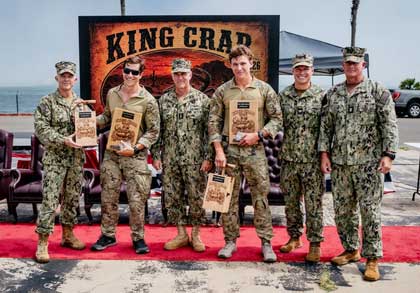 The official party poses for a photo with the winners from Explosive Ordnance Disposal Mobile Unit 2, Explosive Ordnance Disposal Technician 1st Class Nick Wiencek and Explosive Ordnance Disposal Technician 3rd Class James Vosler at the King Crab 2026 awards ceremony on Naval Amphibious Base Coronado, California, August 28, 2026. King Crab is the Navy's premier EOD competition, showcasing elite warfighters who specialize in all-domain EOD operations. Over several days, the tactical challenge pushes the physical endurance, technical proficiency, and combat readiness of competitors to ultimately identify the Navy's most capable two-person EOD team. U.S. Navy Photo by MC2 August Clawson.
Navy Orders Sailors and Families to Scrub Social Media Amid 'Epic Vigilance' Push
Acting Navy Secretary issues force-wide directive to delete military ties online, citing targeted adversary data mining and doxing threats.
In a sweeping move to protect service members and their dependents, the Department of the Navy has issued an internal force-wide directive ordering personnel and their families to immediately scrub their public social media accounts of any military affiliations.
The directive, sent as an all-hands message by Acting Secretary of the Navy Hung Cao, introduces a heightened state of cybersecurity awareness dubbed "Epic Vigilance." The mandate highlights a shifting paradigm in force protection, expanding traditional operational security (OPSEC) rules from active-duty personnel directly to military families and dependents.
The internal notice outlines several immediate actions for sailors, Department of the Navy civilian staff, and their families:
Enforce Strict Privacy: Transition all personal social media accounts from public to private.
Remove Professional Affiliations: Delete any explicit mentions, bios, or indicators linking individuals to the Navy or the Department of the Navy.
Conceal Patterns of Life: Scrub historical posts and refrain from uploading new content detailing daily routines, deployment schedules, or specific duty stations.
Deactivate Hardware Tracking: Disable GPS location services, automated geotagging, and unused Wi-Fi or Bluetooth connections on personal mobile devices.
Military leadership explicitly tied the urgency of the directive to sophisticated digital threats from foreign adversaries. Officials warned that state-sponsored actors are actively scraping public profiles to map out military networks, track personnel movements, and build targeting databases.
Furthermore, the directive acknowledges a rise in online harassment, cyberstalking, and "doxing"—the public release of private identifying information—targeting the spouses and children of service members. By removing the public link between families and the military, the Navy aims to shrink the digital attack surface available to hostile actors during a period of heightened regional and global tensions.
NASCAR will return to Naval Base Coronado during 2027 season
NASCAR will return to San Diego to race at Naval Base Coronado next season, the sanctioning body announced at the end of August, shedding light on a long-term plan for future events at military installations on a rotation basis in 2028 and beyond. The West Coast trip — slated for Aug. 1 on TNT Sports and the cornerstone event of NASCAR San Diego Weekend presented by Anduril — marks the second consecutive season the NASCAR Cup Series will race on the active military base, and the fifth time a street course is on the schedule in the modern era. The NASCAR O’Reilly Auto Parts Series will also join, with the preliminary event planned for July 31 on The CW and the ESPN App. Read the full story on NASCAR website
Department of War, Boeing, and RTX Forge Agreements to Strengthen Production of Critical SM-3 Block IIA and SM-3 Block IB Munitions
The Department of War announced Aug. 14 that it had reached two major framework agreements with Boeing and RTX to increase production capacity for key components of the SM-3 Block IB and SM-3 Block IIA missile interceptors. The agreements are intended to strengthen the industrial base supporting U.S. and allied ballistic-missile defense capabilities at a time when demand for advanced interceptors remains high.
The SM-3 family is a central component of the Aegis ballistic missile defense system, used to defend deployed forces, allies and other strategic assets against ballistic missile threats. The announcement represents a significant industrial and acquisition development because it focuses on expanding the capacity needed to sustain and accelerate future interceptor production. https://www.war.gov/News/Releases/Release/Article/4567790/
department-of-war-boeing-and-rtx-forge-
agreements-to-strengthen-production-of-c/
Secretary of War Hegseth Reaffirms the Trump Corollary to the Monroe Doctrine, Calls on Regional Partners to Take Fight to the Cartels
Secretary of War Pete Hegseth traveled to Panama for the second Americas Counter Cartel Coalition Forum, where he met with regional leaders and participated in PANAMAX 2026 activities. The announcement emphasized expanded cooperation among Western Hemisphere partners against drug-trafficking organizations and other groups identified by the U.S. government as threats to regional security.
The visit also highlighted the strategic importance the Department of War is placing on the Western Hemisphere, including security of the Panama Canal and closer military cooperation with partner nations. The story combines senior-level policy, multinational security cooperation and a major regional military exercise. https://www.war.gov/News/Releases/Release/Article/4573580/
secretary-of-war-hegseth-reaffirms-the-trump-corollary-to-the-monroe-
doctrine-c/
Navy Reserve Expands Bonus Opportunities to Strengthen Recruiting, Retention
by Lt.j.g. Adelola Tinubu
Commander, Navy Recruiting Command
MILLINGTON, Tenn. — The Navy Reserve has introduced expanded bonus opportunities for eligible enlisted Sailors and officers as part of its fiscal year 26/27 Recruiting and Retention Incentive Program, reinforcing its commitment to attracting highly qualified talent and retaining the experienced leaders needed to support the Fleet.
These incentive programs, effective June 1, 2026, provide financial bonuses for eligible personnel affiliating with the Navy Reserve, entering direct commission programs, reenlisting, or continuing their service in critical career fields. The expanded bonuses are designed to strengthen the Selected Reserve by recognizing the value of prior military experience while encouraging continued service in support of national defense.
The incentive programs include four enlisted bonus opportunities: the New Accession Training Enlistment Bonus, Reserve Component Affiliation Bonus, Prior Service Reenlistment Bonus, and Selective Retention Bonus. Depending on eligibility, enlisted Sailors may qualify for bonuses of up to $20,000 for joining, affiliating with, or continuing service in the Selected Reserve.
For officers, the updated policy provides three incentive programs: the Officer Affiliation Bonus, Officer Accession (Direct Commission Officer) Bonus, and Officer Retention Bonus. Eligible officers may receive affiliation bonuses of up to $10,000, direct commission accession bonuses of $12,000, and retention bonuses of up to $12,000 annually for three years in designated communities.
The revised incentives reflect the Navy Reserve's continued focus on building and sustaining a force that is ready to respond whenever and wherever the nation calls.
The incentive programs are one component of the Navy Reserve's broader strategy to recruit, develop, and retain a highly skilled force capable of supporting maritime operations around the world. Prospective applicants and current Sailors are encouraged to speak with a Navy Reserve recruiter or career counselor to determine eligibility and learn more about available bonus opportunities.
For complete eligibility requirements and program guidance, visit the official Navy Reserve Recruiting and Retention Incentive Program policy or contact your local Navy Reserve recruiter.
Navy Decommissions Littoral Combat Ship Fort Worth
by War.gov
The U.S. Navy decommissioned Freedom-variant littoral combat ship, USS Fort Worth (LCS 3) during a ceremony held July 29 at Naval Base San Diego.
As an operational unit and test platform, Fort Worth and its crew played an important role in the defense of our nation and maritime freedom. Fort Worth and its Sailors were key to determining the operational configuration and deployment capabilities of today's LCS platform.
The honorable Gordon England, former Secretary of the Navy, delivered the decommissioning ceremony's principal address. Remarks were also provided by U.S. Navy Rear Adm. Matthew Kawas, the ship's sponsor's proxy, Ms. Jill J.R. Labbe, and U.S. Navy Capt. (ret.) Warren Cupps.
The ceremony honorrf the service and legacy of Fort Worth, as well as the professionalism and dedication of its Sailors and their families.
LCS' are fast, optimally manned, mission-tailored surface combatants that operate in near-shore and open-ocean environments, winning against 21st-century coastal threats. LCS integrates with joint, combined, manned, and unmanned teams to support forward presence, maritime security, sea control, and deterrence missions around the globe.
The LCS class consists of two variants, Freedom and Independence, designed and built by two industry teams. USS Fort Worth is a Freedom-class LCS, built in Marinette, Wisconsin. Austal USA leads the Independence-variant team in Mobile, Alabama, for LCS 6 and the subsequent even-numbered hulls.
By retiring early-hull test platforms like Fort Worth, the Navy redirects investments toward upgrading the remaining LCS inventory with enhanced capabilities. This strategy sustains the LCS program and underscores the Navy's commitment to building America's Fleet of the Future, ensuring the active ships remain relevant, combat-credible, andreliable throughout their service lives.
SecWar Hegseth Presents Mexican Border Defense Medal to Service Members
by C. Todd Lopez
Secretary of War Pete Hegseth recently recognized 50 U.S. service members — including for the first time, Marine Corps personnel — with the Mexican Border Defense Medal.
"From Day 1, operationally, this department, this building, these services rushed, surged down to the border to stop the invasion of our southern border, which is truly what it was," Hegseth said.
The secretary noted that since January 2025, American troops from all services, and with a variety of skills, have been working first to gain and then maintain 100% operational control of America's southern border and to stop both drug traffickers and the flow of illegal immigration.
"You have been dynamic, you have been creative, you have been aggressive, you have used the authorities you've been given [and] you work with your law enforcement partners," Hegseth said, highlighting DOW's partnerships with U.S. Customs and Border Patrol and the Department of Homeland Security.
"That's why, for over a year, there's been effectively zero illegals crossing our border ... especially on the national defense areas," Hegseth said. "We decided our soil, our homeland, will be defended, and we will utilize our troops in those places to do it and give them maximum authorities to ensure that we stop the invasion of our southwest border."
The Mexican Border Defense Medal was established in August 2025. However, the medal itself is not new; it is instead a replica of the Mexican Border Service Medal from 1918. Hegseth said the reuse and reissue of a medal from more than 100 years ago is similar to the department changing its name back to Department of War.
"It's a restoration, it's a reestablishment," he said. "This ... Mexican Border Defense Medal was established in 1918 to stop other incursions and invasions. And so, we're not creating something new; we actually revived the exact same medal from 1918 to be given to all of you today — as a reflection that this service is an extension; we stand on the shoulders of other great Americans who defended this nation."
The secretary said those receiving the medal represent the true 1%, and they represent others like them who also contributed.
"Every single soldier, Marine, and one sailor, seated here represents thousands of others who have done this mission on our southwest border and are doing it right now," he said.
Their work, Hegseth said, keeps Americans safe from illegal immigration and from the poisons illegal drug cartels want to bring over the border, but are now no longer able to.
White House Deputy Chief of Staff Stephen Miller also addressed the medal recipients, saying the border defense effort they participated in was history-making in how quickly and effectively it was implemented.
"I remember distinctly, in the hours after the inauguration, the airlift had already begun," Miller said. "Massive assets were being mobilized and moved down to the southern border. There has never been in history, to my knowledge or awareness, a more radical day-and-night shift in the security posture of a country than what happened to that border between Jan. 20 and Jan. 21 ... and that was led, and driven out, of the Department of War with an urgency and a speed and a ferocity that I have never witnessed before in any other policy area that I have ever worked on."
Now, Miller said, thanks to service members who are defending the U.S southern border and the actions by the president, criminal cartels who want to bring illegal drugs into the United States are no longer able to operate.
CENTCOM Completes Latest Strikes Against Iran
U.S. Central Command said American forces completed another round of strikes against Iran, marking the 12th consecutive night of operations. The strikes targeted Iranian military capabilities, including maritime assets, missile and drone storage facilities, coastal surveillance infrastructure, and air-defense systems. According to the command, the objective is to further reduce Iran's ability to threaten civilian mariners and commercial shipping.
The update also described a broader maritime campaign, saying U.S. forces have redirected nine commercial vessels and disabled one to prevent ships from entering or leaving Iranian ports. More than 50,000 U.S. service members remain deployed across the Middle East, according to CENTCOM. The announcement presents the strikes and maritime measures as part of a sustained effort to constrain Iran's military capabilities and protect commercial navigation.
Nation's Leaders Honor the Fallen During Dignified Transfer
President Donald Trump, Secretary of War Pete Hegseth, Chairman of the Joint Chiefs Air Force Gen. Dan Caine, and other senior leaders attended a dignified transfer at Dover Air Force Base honoring four U.S. soldiers killed while supporting operations in the U.S. Central Command region. The ceremony marked the return of the fallen and provided a formal opportunity for national leaders and military personnel to recognize their service and sacrifice.
The casualties included soldiers killed in an enemy attack at Muwaffaq Salti Air Base in Jordan as well as Sgt. Michael Emmanuel Swinton, who died during a controlled detonation of a downed one-way unmanned aerial system at Erbil Air Base, Iraq. The ceremony underscored the human cost of ongoing U.S. military operations in the region and placed the recent casualties in the broader context of continued American deployments and combat risks.
War Dept Partners With the Genesis Mission to Proliferate AI for Science
The War Department announced its participation in the Genesis Mission, a White House-led initiative intended to use artificial intelligence to accelerate scientific discovery. The department said it would contribute substantial resources and technical expertise to the effort, positioning AI as a tool for advancing research and solving complex scientific problems more rapidly.
The initiative represents a broader effort to connect national-security capabilities with emerging AI infrastructure and scientific research. For the War Department, participation suggests that AI is being treated not only as a military technology but also as a strategic enabler for scientific and technological progress, potentially supporting faster innovation across areas important to national security and defense.
Pentagon's Special Ops Office to Host Rapid Tech Innovation Event
The War Department highlighted an upcoming event focused on accelerating technological innovation for special operations. The event is intended to bring together innovators and defense stakeholders to identify and advance technologies that can address operational needs more rapidly than traditional acquisition processes.
The emphasis reflects the department's growing focus on rapidly fielding emerging capabilities, particularly for specialized forces that operate in demanding environments. The initiative also fits within a broader defense push to shorten the distance between commercial or emerging technology development and practical military applications.
Large-Scale Cybersecurity Exercise Focuses on Operational Technology
Cyber Shield 2026, described as the War Department's longest-running unclassified cyber defense exercise, is placing particular emphasis on operational technology. Military cyber professionals discussed the exercise during a virtual media roundtable, highlighting the importance of defending systems that directly support physical infrastructure and mission operations.
The focus reflects the increasing convergence of cyber and physical security. Protecting operational technology is especially important because attacks against such systems can have consequences beyond data loss, potentially disrupting infrastructure and military operations. The exercise is therefore designed to improve the ability of cyber professionals to identify vulnerabilities and respond to threats affecting real-world mission systems.
NY Guardsmen, Greenland Airports Partner to Improve Lodging Facility
New York National Guard personnel partnered with counterparts in Greenland to improve a lodging facility supporting personnel operating in the Arctic. The project illustrates the practical side of the growing U.S. military relationship with Greenland and the broader importance of infrastructure in maintaining a persistent presence in the strategically significant Arctic region.
The cooperation also demonstrates how National Guard partnerships can support broader defense objectives through relatively small but consequential infrastructure projects. Improving facilities for personnel operating in remote locations can strengthen readiness and sustainment while reinforcing relationships with local and international partners.
DOW Identifies an Army Casualty
The War Department announced the death of an active-duty Army soldier supporting overseas operations in Iraq. Sgt. Michael Emmanuel Swinton was killed at Erbil Air Base during a controlled detonation involving a downed one-way unmanned aerial system. The circumstances surrounding the incident were being investigated.
The announcement highlighted the risks faced by U.S. forces even during activities associated with recovering from or neutralizing enemy attacks. Swinton's death later formed part of the July 22 dignified-transfer ceremony at Dover Air Force Base, where senior national and military leaders honored him and three other soldiers killed in the Central Command region.
Minnesota National Guard, Croatia Celebrate 30 Years of Partnership
The Minnesota National Guard and Croatia marked the 30th anniversary of their partnership under the National Guard Bureau's State Partnership Program during Exercise Combat Power 26 near Slunj, Croatia. The relationship reflects three decades of military cooperation, exchanges, training, and professional engagement between the two partners.
The anniversary highlights the enduring value of state-level military partnerships as a tool for strengthening international relationships. Beyond individual exercises, these programs build familiarity and interoperability among military forces and provide a foundation for cooperation during crises, humanitarian missions, and other shared security challenges.
Coast Guard Monitors Chinese Vessels in the Arctic
The Coast Guard reported monitoring two Chinese research ships as they traveled north through the U.S. exclusive economic zone and across the U.S. extended continental shelf in the Bering Sea. The activity underscores growing U.S. attention to Chinese maritime activity in the Arctic and near North American approaches.
The report is significant because the Arctic is becoming increasingly important to U.S. national security, commercial activity, and strategic competition. Monitoring foreign vessels operating in the region allows U.S. authorities to maintain awareness of activity in waters where geopolitical competition is increasing and where changes in climate and accessibility are creating new opportunities for military and commercial operations.
DOW Identifies Army Casualties
The War Department announced the deaths of two active-duty Army soldiers supporting overseas operations in Jordan. The soldiers were killed during an enemy attack at Muwaffaq Salti Air Base, adding to the casualties associated with U.S. operations in the Central Command region.
The announcement came amid heightened military activity in the Middle East and was followed by the dignified transfer of four fallen soldiers at Dover Air Force Base on July 22. The casualties underscored the continued exposure of U.S. personnel to enemy attacks even at established bases and support locations outside active front-line combat zones.
U.S., Canadian, Thai Navies Sharpen Maritime Capabilities During Exercise
The United States, Thailand, and Canada concluded the Cooperation Afloat Readiness and Training (CARAT) Thailand maritime exercise in Sattahip. The exercise focused on improving combined naval capabilities and reinforcing cooperation among the three countries in support of a free and secure Pacific region.
The exercise illustrates the importance the United States places on maritime partnerships and interoperability in the Indo-Pacific. By training alongside regional and allied forces, the participating navies can improve their ability to communicate and operate together while strengthening relationships that could be important during future contingencies, maritime security operations, or humanitarian responses.
Medal of Honor Recipient Welcomes Newest Student Naval Aviators
Retired Navy Capt. E. Royce Williams, identified by War.gov as the oldest living Medal of Honor recipient, returned to the base where he earned his naval aviator wings. He joined Naval Aviation Schools Command in congratulating 29 student naval aviators who completed their introductory flight evaluation training.
The event connected the history and traditions of naval aviation with the newest generation of aviators entering the fleet. Williams' presence provided the students with a direct link to the service's combat heritage and demonstrated how military institutions use the experiences of decorated veterans to reinforce professional identity, standards, and a sense of continuity among new service members.
Readout of the 45th U.S.-Jordan Joint Military Commission
Assistant Secretary of War for International Security Affairs Daniel Zimmerman and Jordanian Chairman of the Joint Chiefs of Staff Maj. Gen. Yousef Al Hnaity co-chaired the 45th U.S.-Jordan Joint Military Commission in Amman. The commission provided a formal forum for discussing bilateral defense cooperation and the security relationship between the United States and Jordan.
The timing of the meeting is particularly significant given Jordan's role as a key U.S. security partner in the Middle East and the subsequent reporting of U.S. casualties at Muwaffaq Salti Air Base. The commission reflects the institutional side of the relationship, while the events surrounding the base demonstrate the operational importance of U.S.-Jordanian security cooperation.
Department of War Invests $7.1M to Enhance Space Solar Cell Coverglass Manufacturing
The War Department announced a $7.1 million Defense Production Act Title III investment to establish and scale domestic manufacturing of specialized coverglass used for space solar cells in Twinsburg, Ohio. The investment is aimed at strengthening the domestic industrial base for components supporting space-based power systems.
The initiative reflects the department's broader effort to improve supply-chain resilience for strategically important technologies. By expanding domestic manufacturing capacity, the investment seeks to reduce potential vulnerabilities associated with foreign sourcing while supporting the United States' ability to sustain and expand its space capabilities over the long term.
 NAVAL BASE SAN DIEGO (June 27, 2026) – Families of U.S. Navy Sailors assigned to the Ticonderoga-class guided-missile cruiser USS Lake Erie (CG 70) waves as the ship returns to its homeport of Naval Base San Diego following 11 months of sustained operations at sea in the U.S. 4th Fleet area of operations June 27, 2026. An integral part of the U.S. Pacific Fleet, U.S. 3rd Fleet leads naval forces in the region and provides the realistic, relevant training necessary to execute our Navy’s role across the full spectrum of military operations – from combat operations to humanitarian assistance and disaster response. U.S. 3rd Fleet works together with allies and partners to advance freedom of navigation and overflight, the rule of law, and other principles that underpin security for the region. U.S. Navy photo by MCSN Aaron Sandovalmendoza
USS Lake Erie home from deployment
from U.S. 3rd Fleet Public Affairs
SAN DIEGO - Cruiser USS Lake Erie (CG 70) returned to its homeport of Naval Base San Diego on June 27, following 11-months of sustained operations at sea to the U.S. 4th Fleet area of operations.
Lake Erie conducted a wide range of command-and-control and maritime security missions in support of U.S. Southern Command-led Operation Southern Spear.
The ship served as the Integrated Air and Missile Defense Commander and the U.S. Air Force Southern Command’s (AFSOUTH) Regional Air Defense Commander (RADC), supporting operations to counter illicit maritime activity that threatens the security and stability of the United States and our allies and partners.
These efforts resulted in the seizure or disruption of more than 2,900 pounds of narcotics and supported the enforcement of international sanctions against illicit oil smuggling, directly contributing to regional stability and homeland security.
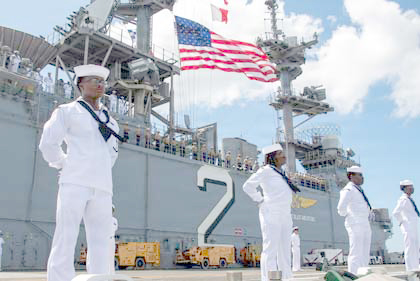 Sailors and Marines aboard the amphibious assault ship USS Essex man the rails while transiting into Pearl Harbor, Hawaii, for Rim of the Pacific 2026, June 21, 2026. The Rimpac multinational exercise fosters relationships critical to ensuring global maritime security.
U.S. Navy photo by Navy Petty Officer Ivan A. Garcia
Sailors and Marines aboard the amphibious assault ship USS Essex man the rails while transiting into Pearl Harbor, Hawaii, for Rim of the Pacific 2026, June 21, 2026. The Rimpac multinational exercise fosters relationships critical to ensuring global maritime security.
U.S. Navy photo by Navy Petty Officer Ivan A. Garcia
30th Rimpac kicks off in Hawaii
Rim of the Pacific, the world's premier international maritime exercise, began June 24 in and around the Hawaiian Islands.
Known as Rimpac, the biennial exercise marks its 30th iteration this year, featuring a multinational force of some 30,000 personnel. It provides a unique training opportunity for allies and partners to strengthen their collective capabilities and promote a free and open Indo-Pacific region.
The exercise, first held in 1971, continues this year through July 31. It will cover a wide range of capabilities including amphibious operations, gunnery and missile proficiency, anti-submarine warfare, air defense exercises, military medicine, humanitarian assistance and disaster response, counter-piracy, mine clearance, explosive ordnance disposal, and diving and salvage operations.
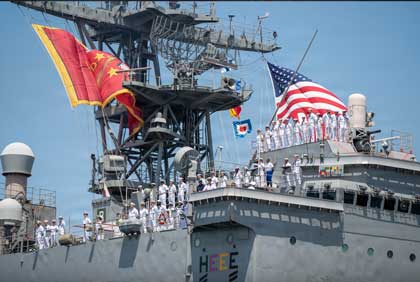
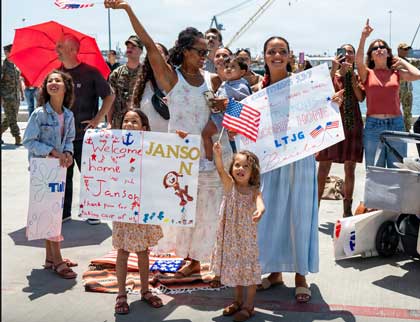
NAVAL BASE SAN DIEGO (June 1, 2026) Sailors assigned to Whidbey Island-class amphibious dock landing ship USS Ashland (LSD 48) man the rails as the ship returns to its homeport of San DIego, June 1, 2026 as families await them on the pier. U.S. Navy photos by MC2 Aja Bleu Campbell.
Task Force Ashland’s Navy-Marine Corps team returns to San Diego after four months of Indo-Pacific ops
June 2, 2026 | Courtesy Story
Marines and Sailors of Task Force (TF) Ashland returned to San Diego aboard Whidbey Island-class dock landing ship USS Ashland (LSD 48), following four months of operations in the Indo-Pacific region, June 1, 2026.Download Icon Download
TF Ashland is composed of Ashland’s crew and a command element from the 15th Marine Expeditionary Unit (MEU); a ground combat element from 3rd Assault Amphibian Battalion, 1st Marine Division; and a logistics combat element from Combat Logistics Regiment 17, I Marine Logistics Group. Assault Craft Unit (ACU) 5 also deployed a detachment with two landing craft, air cushion to support amphibious operations. The task force departed San Diego aboard Ashland Jan. 24, 2026, demonstrating a flexible and scalable model of naval integration.
“I couldn't be prouder of the team's work over these past four months at sea,” said U.S. Navy Cmdr. Adam Peeples, commanding officer of Ashland. “As our Sailors and Marines look back at their accomplishments, I hope they feel the same pride and satisfaction I do leading this team.”
Throughout their underway, the Navy-Marine Corps team was a visible and engaged presence across the Indo-Pacific. The task force participated in a multitude of demanding exercises, including the 45th iteration of Exercise Cobra Gold in February, the largest joint military exercise in mainland Asia, and the 40th iteration of Exercise Balikatan in April, an annual exercise focused on the long-standing alliance between the Philippines and the United States. These exercises involved complex scenarios, such as combined-arms live-fire events, amphibious operations, and disaster response training, conducted alongside the Royal Thai Armed Forces, the Republic of Korea Marine Corps, and the Armed Forces of the Philippines.
“Combining the 15th MEU, ACU-5 craft team, and Sailors of Beachmasters Unit (BMU) 1, the Grizzly Gators of Ashland built something truly greater than the sum of its parts — TF Ashland,” said Peeples. “Together, we tackled the challenges with flawless results and worked with our regional partners, building cooperation within the region and demonstrating our commitment to the most consequential theater.”
While in port at Cebu, Philippines, Ashland completed a three-week ship repair and maintenance (SRMX) exercise, as part of its scheduled port visit. SRMX is designed to rehearse coordination and execution of ship damage repair from forward locations within the Indo-Pacific region, strengthening ties with the skilled workforce within allied and partner countries.
Further showcasing its commitment to regional stability, TF Ashland participated in a multilateral exercise alongside Australian and Canadian forces, a multi-phase exercise focused on surface action group operations and interoperability with allied navies. By executing key components of distributed maritime operations, TF Ashland provided combatant commanders with a flexible force for credible deterrence and crisis response, which significantly enhanced regional capabilities and bolstered maritime security alongside our allies.
“The 15th MEU executed as TF Ashland proved that a task-organized, scalable force can deliver credible combat power while continuing to strengthen relationships with our allies,” said U.S. Marine Corps Lt. Col. Matt Bride, the commander of troops for TF Ashland and the 15th MEU executive officer. “Whether executing complex, multinational exercises or demonstrating the forward-thinking principles of distributed maritime operations, our Navy-Marine Corps team consistently met every challenge with the professionalism and effectiveness that underpins the legacy of our respective organizations.”
TF Ashland’s return marks the completion of operations that reinforced the United States’ commitment to peace through strength.
Task Force Ashland is a flexible, purpose-built force designed to integrate with allies and partners or respond to crisis, in support of a free and open Indo-Pacific.
USS Carl Vinson Earns 2025 Battle “E” Award
June 3, 2026 | Courtesy Story
SAN DIEGO – The Nimitz-class aircraft carrier USS Carl Vinson (CVN 70) earned the 2025 aircraft carrier Battle Effectiveness award announced by Commander, Naval Air Forces, May 1.
The Battle “E” award recognizes U.S. Navy commands that display superior performance during operations, inspections, certifications, assessments and training events in a competitive cycle, assessing their proficiency and overall effectiveness in all phases of operations.
“The Carl Vinson team displayed unrelenting perseverance and superior performance as they successfully carried out sustained operations at sea throughout 2025,” said Capt. Joshua Wenker, commanding officer of Carl Vinson. “Our Sailors worked together to successfully execute a wide range of missions while operating in the Western Pacific and the Middle East, once again setting the standard for courage and steadfastness. I could not be more proud of my team, and their achievements continue to add to the storied history and legacy that has made this ship America's Favorite Carrier!"
Carl Vinson’s deployment accomplishments contributed to their selection for the prestigious recognition. During its nine-month deployment to the U.S. 3rd, 5th, and 7th Fleet areas of operations, the Sailors of the Carl Vinson Carrier Strike Group completed more than 10,000 sorties and 23,000 flight hours, carried out 45 replenishments-at-sea and sailed over 275,000 nautical miles combined.
In addition to the overall command achievement, eleven departments earned distinction, and individual Sailors who served aboard in 2025 have been authorized to wear the Battle “E” ribbon as a visual representation of their excellent performance.
Carl Vinson also earned awards for Carrier Maintenance and Environment Protection and Energy Conservation, demonstrating the ship’s dedication to comprehensive maintenance capabilities and coordinated logistics as a core component to keeping the fleet ready to fight.
Carl Vinson is America’s third Nimitz-class aircraft carrier, and its mission is to conduct carrier air warfare operations and assist in planning, control, coordination and integration of air wing squadrons in support of carrier air warfare. The ship’s namesake honors one of the longest-serving U.S. congressmen in history who had a profound impact on naval shipbuilding and strategic operational capacity with the Two-Ocean Navy Act of 1940.
Carl Vinson is the flagship of Carrier Strike Group (CSG) 1, and CSG-1 consists of Carrier Air Wing (CVW) 2, guided-missile cruiser USS Cape St. George (CG 71), the Zumwalt class DDG USS Michael Monsoor (DDG 1001), the Flight III DDG USS Jack H. Lucas (DDG 125) and the guided-missile destroyers of Destroyer Squadron (DESRON) 1.
An integral part of the U.S. Pacific Fleet, U.S. 3rd Fleet leads naval forces in the Indo-Pacific and provides the realistic, relevant training necessary to execute the U.S. Navy's role across the full spectrum of military operations. U.S. 3rd Fleet works together with allies and partners to advance freedom of navigation, the rule of law and other principles that underpin security for the Indo-Pacific region.
Navy Forecasters Keep Typhoon Watch Around the Clock
June 3, 2026 | by Jenna Cotherman,Commander, Fleet Activities Yokosuka
As another typhoon season approaches, a specialized team of Navy forecasters is already locked in a high-stakes battle against the Pacific's most unpredictable storms.
At the forefront of this effort is the Naval Oceanography Antisubmarine Warfare Center in Yokosuka, Japan, which stands ready to provide the critical weather intelligence required during the Tropical Cyclone Conditions of Readiness season.
Operating around the clock, the command fulfills a dual mission: keeping Navy ships safe at sea and protecting military communities ashore. NOAC also provides weather forecasting for installations throughout the Indo-Pacific region.
"Because the [U.S.] 7th Fleet region is so vast, NOAC's watch floor monitors the oceans 24 hours a day, 365 days a year," said Navy Ensign Ethan J. Tomczyk, public affairs representative for NOAC. "On average, a typhoon forms somewhere in the region every three weeks. When a storm sets its sights on Japan, NOAC kicks into high gear to protect the base."
During the Northern Hemisphere typhoon season, an average of 14 individual typhoons occur that directly impact U.S. military installations in the Indo-Pacific.
"Our watch team is supplemented with an additional team of forecasters whenever a typhoon is forecast to impact Japan," Tomczyk said. "Their task is to monitor the storm's development and compile important information for base and regional commanders to make decisions regarding implementation of safety measures."
A U.S. Coast Guard embarked cutter boat prepares to recover in the notch of the Coast Guard cutter Midgett after completing a passenger transfer with the Philippine Navy frigate BRP Antonio Luna during a maritime cooperative activity in the Philippine Exclusive Economic Zone, May 28, 2026. Photo credit: Coast Guard Petty Officer 3rd Class Austin Wile
Philippine, U.S. Forces Conduct Maritime Cooperative Activity
June 2, 2026 | By Navy Lt. Sarah Merrill, U.S. 7th Fleet
The U.S. Coast Guard partnered with the Armed Forces of the Philippines to conduct a maritime cooperative activity within the Philippine Exclusive Economic Zone, May 26-30. This activity demonstrated a collective commitment to strengthening international cooperation in support of a free and open Indo-Pacific region.
As the sixth activity of 2026, these regular at-sea events strengthen the interoperability of respective military doctrines, tactics, techniques and procedures. For the first time this year, the U.S. Coast Guard participated in an event, represented by the Coast Guard cutter Midgett, alongside Philippine partners.
This cooperative activity focused on critical maritime skills, including visit, board, search and seizure, maritime interdiction operations, search and rescue, and maritime law enforcement training.
Maritime cooperative activities are conducted in a manner consistent with international law and with due regard to the safety, navigational rights and freedoms of all nations.
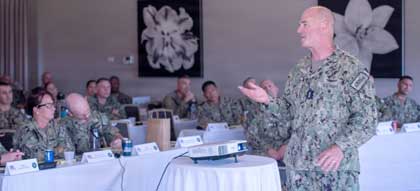 Vice Adm. Scott Gray, commander, Navy Installations Command (CNIC), delivers opening remarks during the 2026 Commander’s Training Symposium at Naval Air Station North Island, May 19. The three-day event brought together Regional Commanders, Installation Commanding Officers, and Command Master Chiefs from across the globe to focus on revitalizing the shore, supporting the Fleet and improving quality of service for Sailors.U.S. Navy photo by Chief Mass Communication Specialist Janweb B. Lagazo.
CNIC Commander Training Symposium: Quality of Life focus
The most relevant official release is a Commander, Navy Installations Command (CNIC) report covering a three-day leadership symposium held at Naval Air Station North Island in San Diego in May 2026. Senior Navy installation leaders gathered to align on “shore enterprise” priorities, with a major emphasis on improving Sailor quality of life across Navy installations in the San Diego region, including housing, barracks modernization, and base support services. The event included discussions on initiatives such as “No Sailor Lives Afloat,” which moves sailors from shipboard living into improved shore-based housing, and leaders also toured modern barracks facilities like Pacific Beacon to evaluate living conditions and ongoing renovation efforts.
The symposium also focused on broader installation readiness and retention concerns, with leadership framing quality-of-life improvements as directly tied to operational effectiveness and recruitment/retention in a competitive workforce environment. Officials emphasized that better housing, infrastructure investment, and family support programs are essential to sustaining a ready naval force, and that coordination between installation commanders is necessary to accelerate improvements across the fleet enterprise.
USS Cleveland (LCS 31) Commissions in Namesake City
The Navy commissioned USS Cleveland (LCS 31) in Cleveland, Ohio, marking the final Freedom-variant littoral combat ship to enter service. The ceremony celebrated both the ship’s namesake connection and the end of a production line that has supported the Navy’s small surface combatant fleet for more than a decade. Officials emphasized the ship’s role in mine countermeasures, surface warfare, and maritime security operations, highlighting its flexibility for deployments in contested littoral environments.
MAKO Storm 2026 Strengthens Navy Reserve Readiness
The MAKO Storm 2026 exercise brought together Navy Reserve Sailors for large-scale training focused on command-and-control, crisis response, and integrated maritime operations. Participants practiced coordinating with active-duty forces in simulated high-end conflict scenarios to improve readiness for rapid mobilization. The exercise is part of broader efforts to ensure Reserve forces can seamlessly integrate into fleet operations during contingencies.
MQ-25 Stingray Advances Toward Production
The Navy moved the MQ-25 Stingray unmanned aerial refueling aircraft program closer to fleet introduction by approving Milestone C, enabling low-rate initial production. The system is designed to extend the range and endurance of carrier-based strike aircraft by providing airborne refueling support. Officials described the MQ-25 as a key step toward integrating autonomous systems into carrier air wings.
U.S. Navy Tests Unmanned Systems with Norway in Arctic
U.S. Navy forces conducted Arctic exercises alongside Norwegian partners to test unmanned and autonomous maritime systems in cold-weather conditions. The training focused on surveillance, undersea awareness, and distributed maritime operations in strategically important northern waters. Officials said the exercise improves allied capability to operate in the Arctic as competition in the region increases.
Promotion Confirmed for Strategic Systems Programs Leader
The Senate confirmed Rear Adm. Douglas L. Williams for promotion to vice admiral and leadership of the Navy’s Strategic Systems Programs. The organization is responsible for maintaining and modernizing the sea-based nuclear deterrent, including submarine-launched ballistic missile systems. Officials noted the importance of SSP in sustaining long-term strategic deterrence capabilities.
Department of War Publishes Second Release of UAP Files
The Department of War announced on May 22, 2026, that it had released a second tranche of declassified Unidentified Anomalous Phenomena (UAP) files through the government’s new transparency initiative known as the Presidential Unsealing and Reporting System for UAP Encounters (PURSUE). According to the release, the new materials were added to the public archive hosted at WAR.GOV/UFO and include historical records, videos, imagery, intelligence reports, witness narratives, and unresolved case files gathered from multiple federal agencies. The Department said the effort is part of a broader directive to identify, review, declassify, and publicly release decades of government records connected to unexplained aerial phenomena. Officials stated that the initiative requires coordination across dozens of agencies and involves reviewing millions of records, many dating back to the mid-20th century.
The release emphasized that the newly posted materials remain categorized as “unresolved cases,” meaning the government has not reached definitive conclusions about the nature of the observed phenomena because of limited or incomplete data. The Department noted that the website had already received more than one billion visits worldwide since launching on May 8, reflecting intense public interest in the disclosure effort. The second tranche includes infrared imagery, radar-related files, historical New Mexico reports from 1948-1950, CIA records involving foreign sightings, NASA-related materials, and military encounter documentation. The Department also confirmed that additional UAP files are being prepared for future rolling releases as the review and declassification process continues.
Marine Corps Blount Island Command Boosts SOUTHCOM Readiness
The Marine Corps’ Blount Island Command in Jacksonville, Florida, supports U.S. Southern Command by maintaining rapid-response maritime prepositioning and ship-to-shore logistics capabilities. The article describes Marines and civilian personnel conducting large-scale loading, maintenance, and deployment exercises designed to ensure equipment and supplies can be rapidly transported during crises, humanitarian missions, or military operations throughout Latin America and the Caribbean. Officials emphasized that the command’s ability to sustain and deploy combat-ready assets strengthens regional deterrence, disaster-response readiness, and operational flexibility for SOUTHCOM missions across the Western Hemisphere. (war.gov)
Statement on Reducing U.S. Brigade Combat Teams in Europe
The Department of War announced plans to reduce the number of U.S. Brigade Combat Teams stationed in Europe from four to three as part of a broader review of global force posture and military readiness priorities. The statement said the adjustment reflects evolving strategic requirements while maintaining the United States’ commitment to NATO collective defense and deterrence operations across the region. Defense officials emphasized that the U.S. will continue rotating forces through Europe, conducting joint exercises with allies, and sustaining rapid-response capabilities to address security challenges posed by Russia and other emerging threats. (war.gov)
Partner Nations Hammer Out Foundation for Digital Transformation at Leadership Summit
Pentagon-hosted meeting of senior defense leaders from the Five Eyes partner nations — the United States, United Kingdom, Canada, Australia, and New Zealand — focused on advancing military digital modernization and interoperability. The summit centered on strengthening secure data sharing, artificial intelligence integration, cloud infrastructure, cybersecurity coordination, and joint command-and-control systems to improve coalition readiness in future conflicts. Officials emphasized that deeper technological cooperation among allied nations is essential for maintaining strategic advantage, accelerating decision-making, and ensuring seamless coordination across increasingly complex global security environments. (war.gov)
Marine Corps aviation modernization updates (2026 Aviation Plan execution)
The Marine Corps continues executing its 2026 Aviation Plan, which restructures Marine aviation to better support distributed maritime operations and expeditionary warfare concepts. The plan emphasizes integration of F-35B Lightning II aircraft as the centerpiece of Marine fixed-wing aviation, alongside increased use of unmanned aerial systems for reconnaissance, targeting, and logistics support. At the same time, the Corps is reducing reliance on legacy platforms and shifting toward more flexible, sea-based and austere-site aviation capabilities that can operate in contested environments alongside naval forces.
Amphibious Combat Vehicle (ACV) driver training modernization
Marine Corps training programs are expanding the use of simulation and advanced instruction methods for Amphibious Combat Vehicle (ACV) operators to improve readiness and reduce training risk. These updates focus on building proficiency in amphibious and land operations while preparing Marines to operate the ACV in complex coastal and expeditionary environments. The modernization effort reflects the broader fielding of the ACV across Marine units and the need to ensure crews can transition seamlessly from legacy platforms like the Assault Amphibious Vehicle.
Marine Corps Force Design 2030 modernization messaging (HQMC)
Force Design 2030 continues to guide the Marine Corps’ transformation into a lighter, more mobile force optimized for maritime denial and distributed operations in contested regions. The concept centers on Marine Littoral Regiments equipped with long-range precision fires, advanced sensors, and integrated unmanned systems to support naval campaigns, particularly in the Indo-Pacific. HQMC messaging emphasizes that this restructuring is intended to improve the Corps’ ability to sense, strike, and maneuver across dispersed island and littoral environments in coordination with the Navy and joint force.
Marine Corps Arctic Campaign – Alaska expansion
The Marine Corps is expanding its Arctic-focused operations under Campaign – Alaska, which integrates rotational forces, cold-weather training, and experimentation with operations in extreme environments. The effort builds on Marine Rotational Force–Alaska to enhance readiness for sustained operations in cold-weather and high-latitude regions, where infrastructure is limited and conditions are harsh. The campaign is designed to improve survivability, mobility, and command-and-control in Arctic conditions while reinforcing strategic presence in a region of increasing geopolitical importance.
Marine Corps body composition policy revision (WHtR system)
The Marine Corps has updated its body composition assessment methodology by introducing a waist-to-height ratio (WHtR) system to replace traditional height-and-weight screening alone. This change aims to more accurately measure health and readiness by focusing on proportional body composition rather than static weight limits. The revised policy is part of broader efforts to modernize fitness standards, reduce injury risk, and ensure Marines meet operational performance requirements while maintaining combat effectiveness.
Naval shipbuilding plan affecting Marine Corps force structure
The Department of the Navy’s FY27 shipbuilding plan has direct implications for Marine Corps expeditionary operations by shaping the availability of amphibious warfare ships required for force projection. Because the Marine Corps relies heavily on Navy amphibious lift to deploy across contested environments, changes in ship procurement, maintenance cycles, and fleet composition affect how Marine units are organized and deployed. The plan reinforces ongoing debates about balancing traditional amphibious capability with new distributed maritime concepts under Force Design 2030.
Marine Corps modernization experimentation and Modern Day Marine planning
The Marine Corps is preparing for Modern Day Marine 2026, a major professional forum showcasing emerging technologies and future warfighting concepts. Planning emphasizes experimentation with autonomous systems, advanced communications networks, and expeditionary logistics innovations designed to support distributed operations. The event serves as a key venue for industry and military collaboration, helping the Corps evaluate technologies that could shape future force design, particularly in contested maritime environments

SAN DIEGO (May 8, 2026) Capt. Loren Jacobi, commanding officer of Naval Base Coronado, poses on the field during NASCAR Day at Petco Park prior to throwing the ceremonial first pitch before a San Diego Padres game, May 8, 2026. NASCAR San Diego Weekend will take place at Naval Base Coronado June 19-21, leveraging the scenic and historic setting to deliver a unique, high-profile sports experience that blends motorsports with pop culture and military heritage. U.S. Navy photo by MC1 Charles J. Scudella III
Department of the Navy releases Fiscal Year 2027 Shipbuilding Plan
WASHINGTON – The Department of the Navy released its Fiscal Year 2027 Shipbuilding Plan on May 11, outlining the Administration’s long-term strategy to expand fleet capacity, strengthen the maritime industrial base, and deliver a more capable, ready, and lethal naval force.
“The United States is at a strategic inflection point, and rebuilding American maritime dominance requires urgency, accountability, and sustained commitment,” said Acting Secretary of the Navy Hung Cao. “This Shipbuilding Plan provides a roadmap for the Golden Fleet, to grow a larger, more capable Fleet while revitalizing the industrial base, strengthening our workforce, and ensuring our Sailors and Marines have the platforms they need to defeat any adversary for decades to come.”
The Shipbuilding Plan reflects a shift toward disciplined execution, industrial base revitalization, and delivery of a more capable, ready, and lethal naval force. The plan prioritizes a balanced high-low mix of platforms and emerging capabilities, strengthens workforce and shipyard capacity, and reinforces accountability to deliver ships on time.
The plan also reflects lessons learned from current operations, evolving global threats, and the need to rapidly adapt force design and acquisition approaches. Continued partnership with Congress remains essential to sustaining momentum and ensuring the Fleet of the Future meets the Nation’s security needs.
The Department noted that the plan includes adjustments to future force structure priorities and select future platforms, informed by operational assessments, industrial base analysis, affordability considerations, and Department-wide strategic planning. The Department will continue refining future force structure and shipbuilding requirements in close consultation with Congress and stakeholders.
“The President's budget request for fiscal year 2027 makes a $65.8 billion generational investment in U.S. Navy shipbuilding. This plan details these investments and the Administration's 30-year investment plan to expand our nation’s Navy shipbuilding capacity and deliver the Golden Fleet,” said Mr. Jason Potter, Performing the Duties of Assistant Secretary of the Navy for Research, Development and Acquisition (ASN RDA). “At the same time, the Navy is holding industry more accountable for both meeting contractual requirements and making capital investments to support this expansion. We are laser-focused on growing the fleet and delivering the ships that our Sailors and Marines depend on.”
The full Fiscal Year 2027 Shipbuilding Plan is available here.
Statement by Chief Pentagon Spokesman, Sean Parnell, on "Establishment of the Department of War COVID-19 Reinstatement and Reconciliation Task Force" and "Reinstating Service Members Unjustly Discharged Under the Coronavirus Disease 2019 Vaccine Mandate" Memorandums
The Department of War continues to take decisive action in support of the many Service members adversely impacted by the COVID-19 vaccine mandate. Today, Secretary Hegseth established the Department of War COVID-19 Reinstatement and Reconciliation Task Force to ensure return-to-service efforts for these warriors are optimized across the force.
He also directed the Secretaries of the Military Departments to ensure their Review Boards evaluate the records of any former Service member who voluntarily left service, and who now requests to return to service through the COVID-19 reinstatement program, to determine whether they were "unjustly discharged." While the Boards will evaluate each case individually based on documented evidence, the Secretary noted that it is appropriate to consider members as unjustly discharged based on evidence showing that adverse actions effectively ended their careers (e.g., letters of reprimand, active or denied vaccine exemption requests, withdrawn assignments, unsatisfactory participation in a Reserve Component, or cancelled enrollments in mandatory Professional Military Education).
The Department continues to welcome back former Service members who were separated solely for refusing to take the COVID-19 vaccine. As of April 2026, nearly 170 warfighters have been reinstated or re-accessed, and the Military Departments are actively tracking more than 800 additional warriors who have expressed interest in returning to service. Individuals now have until April 1, 2027, to take advantage of Department policies on reinstatement with a two-year service commitment. More information can be found here.
The Department continues to right the wrongs of the past and to restore confidence in, and honor to, our fighting force.
The "Establishment of the Department of War COVID-19 Reinstatement and Reconciliation Task Force" memorandum can be found here and the "Reinstating Service Members Unjustly Discharged Under the Coronavirus Disease 2019 Vaccine Mandate" memorandum can be found here.
Golden Dome for America
from Department of War
Senior leaders from the Department of War, U.S. government, and defense industry gathered at Joint Expeditionary Base Little Creek-Fort Story, April 23, to provide an update about Golden Dome for America (GDA), the nation’s initiative to build a next-generation missile defense shield to protect the Homeland.
Speakers represented Secretary of War’s research, engineering and technology office; Golden Dome for America; and North American Aerospace Defense Command (NORAD).
The event, set against a backdrop of current missile defense capabilities, underscored the urgent need to modernize the nation’s defenses against a new generation of advanced threats, as directed by President Trump.
“Golden Dome is the decisive response to a new era of threats,” said Gen. Mike Guetlein, director of GDA. “We are moving with purpose and urgency to forge a shield that is layered, integrated, and automated. The progress on display today is tangible proof that this is not a future concept, but a reality we must build now.”
GDA is a layered defense architecture designed to protect the United States from complex ballistic, hypersonic, and cruise missiles, as well as advanced aerial threats. It enhances national security by integrating a persistent space-based sensor network for global tracking, a portfolio of advanced interceptors providing defense-in-depth, and an integrated command and control system to manage threats at machine speed.
ADT to pay $1.3M to servicemembers for illegal charges
U.S. Justice Dept.
Office of Public Affairs
The Justice Department recently announced that ADT LLC doing business as ADT Security Services, the nation’s largest home security services company, will pay over $1.3 million to resolve allegations that it violated the Servicemembers Civil Relief Act (SCRA) by imposing unlawful charges on at least 3,400 servicemembers who terminated their home security services contracts after receiving military relocation orders.
“Members of our Armed Forces dutifully respond to the defense needs of our Nation, sometimes with very little notice,” said Assistant Attorney General Harmeet K. Dhillon of the Justice Department’s Civil Rights Division. “We’re committed to ensuring that our servicemembers’ rights are protected so that they can focus on their military mission.”
The department alleges that ADT illegally imposed a 30-day notice requirement on servicemembers who terminated their home security contracts.
Read more on page 1 of our May 1 issue
Southcom establishes Autonomous Warfare Command
U.S. Southern Command
April 23, 2026--Marine Corps Gen. Francis L. Donovan, commander of U.S. Southern Command, directed the establishment of the Southcom Autonomous Warfare Command.
The new command will support President Donald J. Trump's National Security Strategy priorities, Secretary of War Pete Hegseth's National Defense Strategy lines of effort, Southcom imperatives, regional security cooperation and operational dominance.
"From the seafloor to space and across the cyber domain, we fully intend to leverage the clear superiority of the American defense ecosystem by deploying cutting-edge innovation and working ever closer with our enduring partners in the region to outmatch those who threaten our collective peace and security," Donovan said.
Once fully established, the new command will employ autonomous, semiautonomous and unmanned platforms and systems to counter threats and challenges across domains, linking tactical missions to long-term strategic effects. It will also collaborate closely with allies and partners in the region to advance shared goals, such as disrupting and degrading narco-terrorist and cartel networks and responding to life-threatening crises caused by large-scale natural disasters.
CNO says food quantity, quality meeting Navy standards aboard ship
CNO Adm. Daryl Caudle disputed reports that sailors were experiencing food shortages and substandard meals aboard several vessels stationed in the Middle East.
During a media roundtable at Sea-Air-Space 2026 in Maryland CNO said that food quantity and quality were meeting Navy standards. His comments came in response to a USA Today article, claiming meals aboard the Nimitz-class aircraft carrier USS Abraham Lincoln and America-class amphibious assault ship USS Tripoli were unappetizing and that small portions were leaving sailors hungry.
“In no way, shape or form, has there been a time where in, at least in this deployment, where they’ve not met the nutritional requirements of our menu,” Adm. Caudle said. “All ships had, I’m going to say, in the strike group, at least 10 days of food, and most were over 30 days of food.”
Hegseth: Flu vaccine optional
by C. Todd Lopez
Annual influenza vaccines are no longer mandatory, said Secretary of War Pete Hegseth in a video posted April 21 on social media.
“The notion that a flu vaccine must be mandatory for every service member, everywhere, in every circumstance, at all times, is just overly broad and not rational,” the secretary said. “Our new policy is simple: If you, an American warrior entrusted to defend this nation, believe that the flu vaccine is in your best interest, then you are free to take it; you should. But we will not force you.”
The secretary signed a memorandum that provides updated guidance that states, effective immediately, the annual influenza vaccine is voluntary for all active and reserve component service members and War Department civilian personnel.
Between Aug. 24, 2021, and Jan. 10, 2023, the department required service members to receive the COVID-19 vaccine. Over 8,000 service members were involuntarily discharged from the military for refusing the vaccine. Hegseth said that won’t happen again.
“Our men and women in uniform were forced to choose between their conscience and their country, even when those decisions posed no threat to our military readiness,” Hegseth said. “That era of betrayal is over. Under President [Donald J.] Trump, the War Department continues to take decisive action to once again restore freedom and strength to our joint force. We’re seizing this moment to discard any absurd overreaching mandates that only weaken our warfighting capabilities.”
Navy destroyer USS Spruance
‘blows hole’ in Iranian ship
President Trump announced April 19 that a San Diego-based warship fired on an Iranian cargo vessel that refused to honor the U.S. blockade, reports the Times of San Diego. In a post on Truth Social, Trump said USS Spruance intercepted the Iranian-flagged container ship Touska in the Gulf of Oman and warned it to stop.“The Iranian crew refused to listen, so our Navy ship stopped them right in their tracks by blowing a hole in the engine room,” Trump wrote in the social media post. Trump said in his post that the Iranian ship is under U.S. Treasury sanctions because of a history of illegal activity. U.S. Central Command subsequently provided further details, saying Spruance disabled Touska’s propulsion by firing several rounds from the destroyer’s 5-inch MK 45 gun into the cargo ship’s engine room. Marines from forward-deployed 31st Marine Expeditionary Unit later boarded the vessel, which remains in U.S. custody. A statement from Iran’s military headquarters, quoted by the Al Jazeera website, vowed to “soon respond to and retaliate against this armed piracy by the U.S. military.”
Caine praises Sailors, Marines enforcing Iran blockade
by David Vergun, Pentagon News
April 16, 2026--During a press conference at the Pentagon today, Air Force Gen. Dan Caine, chairman of the Joint Chiefs of Staff, thanked the sailors and Marines on board vessels in the Persian Gulf enforcing the blockade of ships that sail from Iranian ports.
While all of the Navy ships are critical to this effort, he singled out the destroyers as a prime example.
"The Arleigh Burke-class of destroyers are the backbone of the United States Navy," he said, adding they are "the sports car" of the surface fleet.
The ships are over 500 feet long, weigh around 9,000 tons and, from the keel to the mast, stand nearly 10 stories tall. Their four gas turbine engines can drive the ship at more than 30 knots.
Caine described them as "armed to the teeth" with surface-to-air missiles, land-attack cruise missiles, antiship missiles, antisubmarine rockets, torpedoes, five-inch naval guns, multiple electronic warfare systems and embarked helicopters, extending their reach and capability. However, despite the weaponry, he said the most important weapons on board these ships are the 300 sailors who bring them to life.
"They are the heart and soul of these warships at sea," Caine said, noting that they are deployed for months, operating around the clock in a constant state of readiness, always delivering capability to the joint force.
It's hot in the engine room, where the engineering team keeps the lights on and the ship powered and able to respond to the orders from the bridge. On the bridge are sailors maintaining a constant watch, maneuvering the ship tactically and safely through always-congested waters, the general said.
"It's like driving a sports car through a supermarket parking lot on a payday weekend with thousands of kids in that parking lot, as you attempt to maneuver through there to get to that ship that would attempt to run that blockade," he said.
Down in the combat information center is where the decisions are made. As threats appear, sailors make real-time decisions on how to identify and handle them.
"And they always deliver," Caine said, noting that these ships are often run by the youngest sailors in the surface warfare fleet.
The helmsman, who is on watch in the bridge, is normally between 18 and 19 years old, and "they are trusted to drive this warship through that supermarket parking lot without hitting anything," he said.
The conning officer, who's normally just a few years out of college, is the one giving that young helmsman the orders on where to take that warship to execute the mission.
"These are incredibly well-trained sailors. They are led by incredible leaders — salty, experienced leaders — and trusted with deep responsibility, and I'm so humbled and proud of America's Navy. These sailors chose to take the road less traveled, to go into the historic surface Navy, and they deliver every single day," the chairman said.
USS Savannah (LCS 28) changes homeport from San Diego to Portland
by Lt. Brinn Hefron
PORTLAND, Oregon. - The Independence-variant littoral combat ship USS Savannah (LCS 28) departed Naval Base San Diego April 8 and arrived at its new homeport of Portland, Ore. April 12.
While Savannah is in Portland, the ship will be entering into a Docking Selected Restricted Availability (DSRA) to receive lethality and survivability upgrades.
“Maintaining combat readiness begins with ready platforms and we are excited for the warfighting upgrades that Savannah will receive.” said Capt. James Hoey, commodore, Littoral Combat Ship Squadron One. “This modernization will improve Savannah’s lethality to better support Fleet Commanders’ missions.”
During the upgrade, Savannah will receive a comprehensive overhaul of its combat systems suite. This includes the integration of the Naval Strike Missile, installation of the Navy’s electronic warfare system Surface Electronic Warfare Improvement Program Lite, and the addition of the Nulka decoy-launching system. The ship will also receive the Autonomous Weapon System, a new common combat management system. Upon completion of the lethality and survivability upgrade and return to San Diego, Savannah will receive the Mine Countermeasures Mission Package.
Savannah completed a 12-month rotational deployment throughout the U.S. 3rd and 7th Fleet areas of operation in August 2025. While on deployment, the Savannah conducted presence operations and engagements with allies and partners throughout the region to maintain a secure and prosperous Indo-Pacific.
VA 100,000 new enrollees in 2026
The VA announced April 6 that more than 100,000 new veterans have enrolled in VA healthcare so far in 2026. This milestone was reached on March 31, significantly faster than in six of the last seven years. VA Secretary Doug Collins attributed this surge to the department’s transformation into a “service organization” where veterans come first, noting that historic improvements in facility access and benefit processing are driving the increased engagement. Significant improvements since January 2025 have contributed to this growth, including the opening of 34 new healthcare facilities and the reduction of the benefits backlog by 67 percent. The VA has also offered over 2.2 million appointments outside of normal operating hours, providing more timely and convenient options for those with civilian work schedules. SOURCE: Fleet Reserve Association
Hegseth, Indonesian counterpart announce defense partnership
Secretary of War Pete Hegseth welcomed his Indonesian counterpart — Defense Minister Sjafrie Sjamsoeddin — to the Pentagon April 13, where the two men announced the establishment of the Major Defense Cooperation Partnership between the two countries.
The partnership will serve as a framework to advance bilateral defense cooperation between the U.S. and Indonesia in order to maintain peace and stability throughout the Indo-Pacific region.
The new cooperation agreement features three “foundational pillars” that are based on each country’s national sovereignty and mutual respect: military organization and capacity building; training and professional military education; and exercises and operational cooperation.
The U.S. and Indonesia have maintained formal diplomatic relations for more than 75 years, and established ties in 1949, just after Indonesia’s war for independence from the Netherlands.
Former Army employee and top secret clearance holder arrested and charged with leaking classified national defense information
Department of Justice Office of Public Affairs
The FBI arrested Courtney Williams, 40, of Wagram, N.C., recently and a federal grand jury indicted her in connection with her alleged transmission of classified national defense information to individuals not authorized to receive it, including a journalist.
“Clearance holders accept a solemn obligation to protect the classified information entrusted to them,” said Assistant Attorney General for National Security John A. Eisenberg. “That they do so is critical to the security of our Nation. When clearance holders violate that trust, the National Security Division will act swiftly to hold them accountable.”
According to court documents, from 2010 to 2016, Williams worked for a special military unit and held a top secret / sensitive compartmented information security clearance. As a clearance holder, Williams received training as to the proper handling, safeguarding, and storage of classified information.
Williams also signed a classified nondisclosure agreement which, in relevant part, confirmed her understanding that the unauthorized disclosure of classified information could constitute a criminal offense. In her role at the SMU, Williams had daily access to a broad range of classified information.
As alleged, between 2022 and 2025, Williams repeatedly communicated with the journalist via telephone and text messages. During this period, Williams and the journalist had over 10 hours of telephone calls and exchanged more than 180 messages. In one such message, the journalist identified themselves as a journalist and stated that they sought information about the SMU in support of an upcoming article and book.
Read the full story on page 2 of our April 16-30 issue...click here
USS John P. Murtha supports NASA's Artemis II mission
by MC1 Jomark Almazan
SAN DIEGO – Amphibious transport dock ship USS John P. Murtha (LPD 26) served as the recovery ship for the Orion spacecraft and its crew upon their return from the historic Artemis II mission.
The ship is named in honor of the late and long-serving Pennsylvania Congressman John P. Murtha. Read more...
Hegseth authorizes off-duty service members to carry private firearms on installations
by Matthew Olay, Pentagon News
Secretary of War Pete Hegseth signed a memorandum directing military installation commanders to allow War Department personnel — namely, uniformed service members — to request to carry privately owned firearms while in their nonofficial duty capacity on DOW property within the United States.
“Before today, it was virtually impossible … for War Department personnel to get permission to carry and store their own personal weapons aligned with the state laws where we operate our installations. … Well, that’s no longer,” Hegseth said during a social media video released April 2.
“The memo I’m signing today directs installation commanders to allow requests for personal protection — to carry a privately owned firearm — with the presumption that it is necessary for personal protection,” he said.
At the video’s outset, Hegseth said the U.S. Constitution’s Second Amendment applies to all Americans, including those in uniform.
“The War Department’s uniformed service members are trained at the highest and unwavering standards. These warfighters — entrusted with the safety of our nation — are no less entitled to exercise their God-given right to keep and bear arms than any other American,” Hegseth said.
He then cited several active-shooter incidents on U.S. military installations in recent years as examples of when personnel having the ability to return fire on the threat could potentially have reduced the human damage inflicted.
Specifically, Hegseth mentioned the Dec. 9, 2019, terrorist attack at Naval Air Station, Pensacola, Florida, which killed three men and injured eight others; the Aug. 6, 2025, shooting and wounding of five soldiers by one of their fellow soldiers at Fort Stewart, Georgia; and the shooting of two individuals — one whom died — at Holloman Air Force Base, New Mexico, as recently as March 17.
“Recent events … have made clear that some threats are closer to home than we would like,” he said.

PACIFIC OCEAN (March 4, 2026) The specialized Launch and Recovery System (LARS) returns the pressurized rescue module (PRM-1) Falcon aboard Hornbeck Offshore Services (HOS) ship Mauser following the completion of a controlled manned dive evolution off the coast of San Diego, March 4, 2026. URC is composed of active duty and Reserve Component Sailors and operations and maintenance contractor located in San Diego, Calif., and is home to the U.S. Navy’s manned deep diving submarine rescue submersible. The team provides administrative, maintenance, operations, and logistics oversight for the Submarine Rescue Diving and Recompression System (SRDRS) and Sibitzky Remotely Operated Vehicle (ROV). U.S. Navy photo by MC1 Tiarra Brown.
Submarine Rescue Diving and Recompression System completes certification
From Team Submarine Public Affairs
The U.S. Navy certified the Submarine Rescue Diving and Recompression System (SRDRS) for full operation, March 23, clearing the system for deployment in support of undersea rescue missions around the globe.
The certification concluded with a final manned dive in the waters near Naval Air Station North Island, Calif., March 6, and marks the culmination of a multi-year collaboration between the Undersea Rescue Command (URC), Submarine Squadron 11, Commander, Submarine Force, U.S. Pacific Fleet, Commander, Submarine Forces, Naval Sea Systems Command, Program Executive Office Attack Submarines, and the Undersea Special Missions Program Office (PMS 390).
“This successful dive signifies a major milestone for the Navy,” said Rear Adm. Jonathan Rucker, Program Executive Officer, Attack Submarines. “We hold ourselves to extremely high standards in the undersea community. Going through this process shows that the team is ready to meet and exceed those standards. This accomplishment is a direct result of the whole team’s dedication.”
The SRDRS is a remotely operated system capable of rescuing submarine crews in cases of emergency and can deploy anywhere in the world within 96 hours. With the successful system certification, the URC team is authorized to assist in submarine rescues globally, joining an international force of experts ready to help those in need.
"Our Submarine Force operates, along with our allies and partners, in challenging undersea environments that span the entire globe. It is critical for us to have an undersea rescue capability that underpins the extensive training our submariners receive and that allows us to respond worldwide in the event of a distressed submarine," said Rear Adm. Chris Cavanaugh, commander, Submarine Force, U.S. Pacific Fleet. "I commend the team of experts that helped us to achieve this important certification and to maintain our legacy of safe operations beneath the seas."
The SRDRS is one of the Navy’s primary undersea rescue capabilities and is designed to support both U.S. and allied rescue operations worldwide. Its main component, the Pressurized Rescue Module (PRM), is a tethered, remotely operated vehicle capable of rescuing up to 16 personnel per sortie.
“Being onboard the PRM during its certification dive to 2,000 feet was an awe-inspiring experience, demonstrating the effectiveness of this system, and the professionalism and expertise of the entire team,” said Capt. David McGlone, Program Manager for PMS 390.
Navy commissions submarine USS Massachusetts (SSN 798)
by Petty Officer 2nd Class Kaitlin Young
BOSTON — March 28, 2026 — The Navy commissioned the Virginia-class fast-attack submarine USS Massachusetts (SSN 798) in a traditional ceremony held March 28 at Boston Harbor.
The ceremony culminated a years-long process to bring Massachusetts into service. It is the fifth U.S. Navy vessel named after the commonwealth of Massachusetts, following the most recent, USS Massachusetts (BB 59), a South Dakota-class fast battleship that participated in nearly every major Pacific campaign from 1943 to 1945 and earned 11 battle stars for its World War II service.
As it joins the fleet, Massachusetts (SSN 798) brings significant warfighting capability, underscoring the nation’s asymmetrical advantage at sea. Virginia-class fast attack submarines have enhanced stealth, sophisticated surveillance capabilities and special warfare enhancements that enable them to meet the Navy’s multi-mission requirements.
Each Virginia-class submarine is 7,800 tons and 377 feet in length and has a beam of 34 feet. It is designed with a reactor plant that will not require refueling during the planned life of the ship, reducing lifecycle costs while increasing underway time.
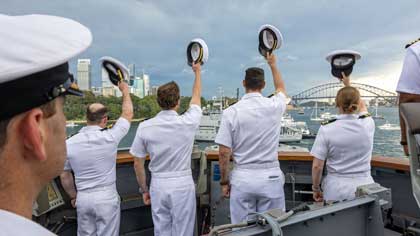
U.S. Navy Sailors assigned to Arleigh Burke-class guided-missile destroyer USS Fitzgerald (DDG 62) render honors to the Leeuwin-class survey ship HMAS Leeuwin (A 245) during a fleet review as a part of Exercise Kakadu in Sydney, March 21, 2026. Exercise Kakadu is the Royal Australian Navy’s premier exercise and provides an opportunity for regional nations to participate in multinational maritime activities. Fitzgerald is forward-deployed and assigned to Destroyer Squadron (DESRON) 15, the Navy’s largest DESRON and U.S. 7th Fleet’s principal surface force. U.S. Navy photo by MC2 Timothy Dimal.

Operation ICE CAMP 2026: BEAUFORT SEA, Arctic Circle - The northern lights appear over Ice Camp Boarfish during Operation ICE CAMP 2026. ICE CAMP Boarfish is a three-week operation designed to research, test, and evaluate operational capabilities in the Arctic region. In addition to U.S. Navy, U.S. Marine Corps, and Air National Guard participation, personnel from the Royal Australian Navy, Royal Canadian Navy, Royal Canadian Air Force, French Navy, Royal Navy, Norwegian Defence Research Institute, and the Japan Agency for Marine-Earth Science and Technology are also taking part. This operation, held biennially, partners with the ASL and was elevated from an exercise to an operation to better reflect the Navy’s strategic priorities in the Arctic. ICE CAMP provides the necessary training to maintain a working knowledge of a constantly changing region. U.S. Navy photo by MC1 Bryan Mai.
Returning Chaplain Corps to mission of serving the spiritual needs of warfighters
Secretary of War Pete Hegseth provided an update, March 24, on efforts to return the Chaplain Corps to its mission of serving the spiritual needs of warfighters — 82% of whom identify as religious, Wilson noted.
The faith and belief coding system has been renamed to religious affiliation codes and simplified from more than 200 faith codes.
"Based on recommendations from our internal review committee, the department will now use 31 religious affiliation codes. Most of the military population only use six codes. We've gotten rid of the ones that were impractical and unusable," Wilson said.
Also, Hegseth signed a memo that directs chaplains, all of whom are officers, to replace rank insignia on their duty uniforms with religious insignia, she said.
"This removes any unease or anxiety a junior officer, enlisted personnel and even a senior officer may have in seeking guidance on sensitive or spiritual matters. These reforms are just the start of restoring the esteemed position of chaplains as moral anchors of our fighter force," she said.
Hegseth said the overhaul was necessary because the current system had grown too large.
"A chaplain is first and foremost a chaplain, and an officer second. This change is a visual representation of that fact," he said.
Hegseth emphasized the importance of empowering chaplains, noting "theirs is a high and sacred calling, but they can only be successful if they are given the freedom to boldly guide and care for their flock."
Department of War update
by David Vergun, Pentagon News
March 13, 2026--More than 50,000 service members are supporting Operation Epic Fury, which started Feb. 28, said Pentagon Press Secretary Kingsley Wilson today in the War Department's Weekly Sitrep video.
Those forces have established control over air and sea domains and struck thousands of identified Iranian targets, demonstrating operational dominance, she said.
"We continue to deliver devastating combat power. Every day our resolve increases and the regime's ability to threaten our forces, our partners and the American people, is being systematically dismantled," Wilson said.
Weapons employed in the operation, per the fact sheet, include a wide range of bombers, fighter jets, electronic warfare and reconnaissance aircraft, unmanned aerial systems, missile defense platforms, artillery systems, warships, counter-drone equipment, refueling assets and cargo aircraft.
Arctic Edge 2026 wraps up
The North American Aerospace Defense Command and U.S. Northern Command concluded Arctic Edge 2026, a three-week, multidomain field training exercise conducted across Alaska and Greenland.
U.S., allied and interagency partners trained together to sharpen Arctic operations, improve interoperability and strengthen homeland defense capabilities in the high north.
Key objectives of the exercise, according to a Northcom press release, were:
Cruise missile defense;
Coordination with interagency partners on the protection of critical infrastructure such as power grids in Alaska;
Counter-small UAS defense;
Joint and service-level experimentation and technology demonstrations;
Arctic survival and mobility training in Greenland.
Narco-trafficking kinetic strike
On March 8, at the direction of U.S. Southern Command commander, Marine Corps Gen. Francis L. Donovan, Joint Task Force Southern Spear conducted a lethal kinetic strike on a vessel operated by a designated terrorist organization, achieving its objective without U.S. casualties, Pentagon Press Secretary Kingsley Wilson said.
Intelligence confirmed the vessel was transiting along known narco-trafficking routes in the eastern Pacific, and the operation resulted in the elimination of six male narco-terrorists.
Commissaries start selling single-use paper and plastic bags on April 6
by DeCA Corporate Communications
March 16, 2026, FORT LEE, Va. – Starting April 6, commissaries will start charging a nominal price for each single-use paper or plastic bag.
Cost associated with this change is 5 cents for plastic and 10 cents for paper single-use bags.
This change will allow the Defense Commissary Agency (DeCA) to continue to offer its eligible patrons significant savings while strengthening its fiscal stewardship and reducing operating expenses.
Patrons submitting Commissary CLICK2GO® curbside or delivery orders will be given the option to purchase bags when checking out.
DeCA also encourages patrons to bring their own bags from home or purchase reusable bags from in-store or Commissary CLICK2GO® assortments.
For more information, please visit https://shop.commissaries.com/bags
Secretary of War Pete Hegseth and Chairman of the JCS Gen. Dan Caine March 10, 2026 press briefing
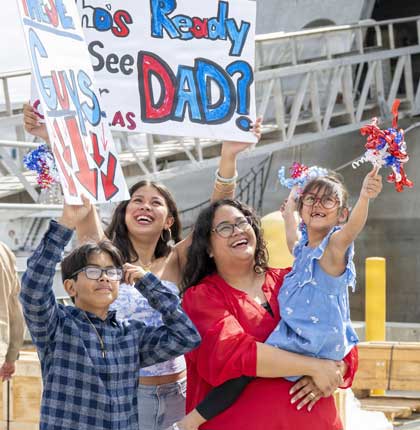
NAVAL BASE SAN DIEGO (March 4, 2026) — Families greet their Sailors upon arrival of Independence-variant littoral combat ship USS Cincinnati (LCS 20) to its homeport of Naval Base San Diego after eight months of sustained operations in the U.S. 3rd and 7th Fleet areas of operations, March 4, 2026. Littoral combat ships are fast, optimally manned, mission-tailored surface combatants that operate in near-shore and open-ocean environments, winning against 21st-century threats. LCSs integrate with joint, combined, manned, and unmanned teams to support forward presence, maritime security, sea control, and deterrence missions around the globe. U.S. Navy photo by MC2 Aja Bleu Campbell.
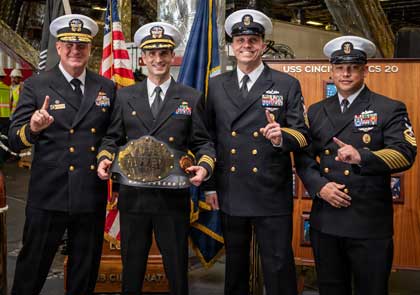
Rear Adm. Brent DeVore, commander, Expeditionary Strike Group 3, left, poses with the leadership of the Independence-variant littoral combat ship USS Cincinnati (LCS 20) after eight-months of sustained operations at sea in the U.S. 3rd and 7th Fleets, March 4, 2026. The Cincinnati returned to its homeport of San Diego after eight months of sustained operations in the U.S. 3rd and 7th Fleet areas of operations. Littoral combat ships are fast, optimally manned, mission-tailored surface combatants that operate in near-shore and open-ocean environments, winning against 21st-century threats. LCSs integrate with joint, combined, manned, and unmanned teams to support forward presence, maritime security, sea control, and deterrence missions around the globe. U.S. Navy photo by MC1 Brandon Roberson.
USS Cincinnati (LCS 20) returns to homeport in San Diego
by Lt. Brinn Hefron
Independence-variant littoral combat ship USS Cincinnati (LCS 20) arrived at its San Diego homeport following eight months of sustained operations at sea, March 4.
Cincinnati conducted several multilateral exercises and port visits in the U.S. 3rd and 7th Fleet areas of operations throughout the Indo-Pacific, including Brunei, Cambodia, Indonesia, Malaysia, the Philippines, the Republic of the Marshall Islands, Singapore, enhancing regional maritime cooperation and interoperability. Cincinnati participated in Cooperation Afloat Readiness and Training (CARAT) exercises with members of the Association of South East Asian Nations (ASEAN) throughout the Pacific.
“I am immensely proud of the crew for their exceptional performance during our sustained operations abroad,” said Cmdr. Andrew Recame, commanding officer of Cincinnati. “This was a significant milestone, not only for the ship and its crew, but for the entire LCS program. For eight months, Team Cincy operated boldly in the U.S. 7th Fleet area of operations, demonstrating the versatility and capability of the U.S. Navy wherever we went. The dedication and professionalism of our Sailors has been truly outstanding, and they have represented the best of America’s spirit on the high seas and foreign shores.”
Read full story
Update on the War Department's partnership with Scouting America
Last week, Secretary of War Pete Hegseth delivered an update on the War Department's partnership with Scouting America, formerly known as the Boy Scouts of America.
"After putting them on notice, they stepped up and promised reform," Wilson said, noting that the organization has now committed to eliminating its diversity, equity and inclusion efforts, scrapping the citizenship and society merit badge, basing all membership strictly on biological sex at birth, introducing a new military service merit badge and waiving fees for children of active-duty troops.
The department will hold a six-month compliance review to ensure these promises become permanent.
"This is how we raise the next generation of strong, merit-driven, patriotic Americans who will one day defend this nation — back to basics, back to excellence," she said.
U.S. forces launch Operation Epic Fury, Feb. 28
USCENTCOM
TAMPA, Fla. – U.S. Central Command (CENTCOM) commenced Operation Epic Fury, Feb. 28, at the direction of the President of the United States.
U.S. and partner forces began striking targets at 1:15 am ET to dismantle the Iranian regime’s security apparatus, prioritizing locations that posed an imminent threat. Targets included Islamic Revolutionary Guard Corps command and control facilities, Iranian air defense capabilities, missile and drone launch sites, and military airfields.
“The President ordered bold action, and our brave Soldiers, Sailors, Airmen, Marines, Guardians, and Coast Guardsmen are answering the call,” said Adm. Brad Cooper, commander of CENTCOM.
Following the initial wave of U.S. and partner strikes, CENTCOM forces successfully defended against hundreds of Iranian missile and drone attacks. There have been no reports of U.S. casualties or combat-related injuries. Damage to U.S. installations was minimal and has not impacted operations.
The first hours of the operation included precision munitions launched from air, land, and sea. Additionally, CENTCOM’s Task Force Scorpion Strike employed low-cost one-way attack drones for the first time in combat.
Operation Epic Fury involves the largest regional concentration of American military firepower in a generation.
UPDATE FROM CENTCOM ON X Saturday, March 1, 2026: TAMPA, Fla. – As of 9:30 am ET, March 1, three U.S. service members have been killed in action and five are seriously wounded as part of Operation Epic Fury. Several others sustained minor shrapnel injuries and concussions — and are in the process of being returned to duty. Major combat operations continue and our response effort is ongoing. The situation is fluid, so out of respect for the families, we will withhold additional information, including the identities of our fallen warriors, until 24 hours after next of kin have been notified.
SecNav Phelan remarks 2026 WEST
President Trump’s Golden Fleet reflects an America First commitment to national security, American industry, the American worker and Taxpayer. The era of accepting delays, underperformance and readiness-eroding backlogs without consequence is over. That sense of urgency matters; because today, we are no longer competing on intent, rhetoric, or aspiration. We are competing on speed, scale, and execution.
And I want to be very clear with this audience: the Golden Fleet is not a political slogan, or just the battleship. The Golden Fleet is America’s shipbuilding renaissance, restoring American industrial power, integrating unmanned and AI enabled systems, and partnering with the private sector to deliver capability at the speed of relevance. Today, I will leave you with what the Golden Fleet is, what has been broken, and how unmanned, AI and industry partnerships focused on delivering capability are critical enablers across the three pillars of the Golden Fleet.
Read speech here
CNO remarks to Navy Submarine League Pacific Southwest in San Diego February 2026 - as prepared
Read here
Commissary home delivery program expands across the U.S.
by C. Todd Lopez. Pentagon News
Home grocery delivery from the commissary has arrived at dozens of military bases across the U.S.
As part of the Defense Commissary Agency’s CLICK2GO® on the GO! program, service members and their families can shop and pay for groceries at the commissary online using a credit card, and then have those groceries delivered to their home.
Delivery fees are distance-based and competitively priced. The service is typically available Monday through Friday from 11 a.m. to 6 p.m., though hours may vary by location.
“CLICK2GO® is bringing convenience to our military community, increasing their access to commissary savings and making affordable, nutritious foods even more accessible. Service members and their families can order online, secure household staples, fresh produce and proteins, and have them in hand hours later,” said Undersecretary of War for Personnel and Readiness Anthony J. Tata.
Home delivery is not a new concept for the commissary. In May 2022, DeCA piloted home delivery at eight locations, including MCAS Miramar, Camp Pendleton and Naval Base San Diego; MacDill AFB, Florida; Scott AFB, Illinois; Fort Bragg, N.C.; Fort Belvoir and Naval Station Norfolk, both in Virginia; and Fort Lewis, Wash.
Now, the pilot has expanded to an additional 62 stateside stores, for a total of 70 locations. DeCA is exploring opportunities to expand the service to its other 108 continental U.S. stores.
The delivery program is meant to both enhance the competitive advantage of military commissaries and strengthen readiness in the force by taking a burden off families and service members, so they can better focus on the military mission.
“CLICK2GO® is designed to make their lives easier, providing our military families with the ability to order online from the local commissary the same way they would from a national chain,” Tata said.
Destroyer Truxtun, oiler Supply collide in SOUTHCOM
USNI News reported that Navy destroyer USS Truxtun and fast oiler Supply collided during an underway replenishment on Feb. 11, according to a U.S. Southern Command statement. “Two personnel reported minor injuries and are in stable condition. Both ships have reported sailing safely. The incident is currently under investigation,” reads a statement provided to USNI News. A spokesperson from SOUTHCOM confirmed to USNI News the injured personnel were Sailors. Truxtun left Naval Station Norfolk, Va., earlier this month as an independent deployer. Supply is also based in Norfolk.
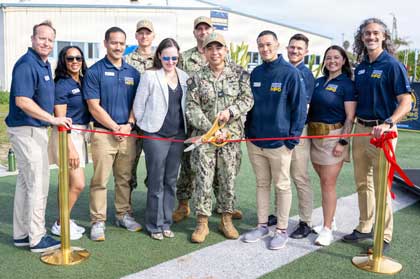
Navy Capt. Brian C. Bungay, Naval Base San Diego commanding officer, center, and base leadership are joined by Harborside Sports and Fitness Complex leaders during the grand opening of the Navy's first and only Human Performance Optimization Program, Feb. 2, 2026. The program is a comprehensive, performance-based initiative designed to enhance an individual's physical, mental, emotional and nutritional capabilities in order to maximize effectiveness, productivity and overall well-being. U.S. Navy photo by MC2 Aja Bleu Campbell
Naval Base San Diego optimizes warfighter fitness
by Navy Lt. Drew Verbis, Naval Base San Diego Public Affairs
The Navy's first and only Human Performance Optimization Program is officially open for business on board Naval Base San Diego. Navy Capt. Brian Bungay, base commanding officer, marked the milestone during a ribbon-cutting ceremony at the Harborside Sports and Fitness Complex Feb. 2.
The program is a comprehensive, performance-based initiative designed to enhance an individual's physical, mental, emotional and nutritional capabilities in order to maximize effectiveness, productivity and overall well-being.
"The Navy's vision is clear — to enhance individual and team effectiveness by ensuring the health and viability of our warfighters," Bungay said. "We must treat our sailors like world-class athletes, and the HPO initiative is a direct reflection of that vision."
Navy fitness is expanding beyond traditional gym access and group exercise by introducing specialized staff, performance education and recovery-focused services specifically tailored to support warfighter readiness and resilience.
"As we move forward with the Total Sailor: Fit to Fight initiative, we must have the tools in place to ensure sailors remain our top priority and are postured for maximum combat readiness," said Navy Master Chief Petty Officer Brian S. Metzger, Naval Surface Force, U.S. Pacific Fleet, command master chief. "The HPO Program brings top experts in nutrition, cognitive performance and fitness together under one roof — right near the waterfront — which is exactly what our sailors need and something that has never been done before."
Bungay emphasized that the program is designed to provide sailors with the resources necessary to build and sustain peak physical and mental performance.
"While Navy fitness focuses on general facility access, group exercise and standard routines, HPO delivers the Navy's first performance-based program that supports the warfighter both inside and outside traditional brick-and-mortar facilities," Bungay said. "It's a place where sailors can push their limits, build resilience and develop the physical and mental toughness required to meet any challenge."
Mary Kirby, Fleet and Family Readiness regional program director for Navy Region Southwest, echoed that sentiment, highlighting what sets HPO apart from existing programs.
"Our [morale, welfare and recreation] fitness programs are outstanding, but sailors typically choose their own path," Kirby said. "What's different here is that sailors begin with a series of evidence-based assessments."
Those assessments — conducted by specialized, credentialed staff operating within defined professional scopes — include body composition analysis, recovery modalities, physical training evaluations, sleep and recovery strategies, stress management tools and nutrition fueling education.
"This model has been available at off-base commercial businesses and within select special warfare communities, but we're excited to be the first to offer it at the installation level," Kirby said. "Once metrics are collected and evaluated, the intent is to expand this program across the enterprise."
Navy Petty Officer 2nd Class Troy Torres, an intelligence specialist assigned to Expeditionary Strike Group 3, encouraged fellow sailors to take advantage of the program.
"Step one is easy — come to the [Harborside Sports and Fitness Complex]," Torres said. "Step two, talk with an HPO specialist. You'll quickly realize that fitness isn't just about gym equipment, sets and reps."
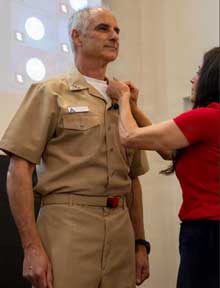 |
NAVAL AIR STATION NORTH ISLAND, Calif. (Feb. 2, 2026) – Rear Adm. Douglas “V8” Verissimo is pinned by his wife, Amanda Verissimo, to vice admiral during his promotion and change of command ceremony, as he assumes the title of commander, Naval Air Forces (CNAF) onboard Naval Air Station North Island, Feb. 2, 2026. The mission of CNAF is to man, train and equip deployable, combat-ready Naval Aviation forces that win in combat. U.S. Navy photo by MC3 James Peer. |
Commander, Naval Air Forces, U.S. Pacific Fleet Conducts change of command and promotion ceremony
by Ensign Alexis VanBuren, Commander, Naval Air Forces
Commander, Naval Air Forces (CNAF) held a change of command and promotion ceremony at the command’s auditorium onboard Naval Air Station North Island, Feb. 2.
Adm. Stephen Koehler, commander, U.S. Pacific Fleet, presided over the ceremony as Vice Adm. Douglas “V8” Verissimo assumed duties as commander, Naval Air Forces and commander, Naval Air Force, U.S. Pacific Fleet. During the ceremony, Verissimo was also promoted to vice admiral.
Verissimo relieved Vice Adm. Daniel “Undra” Cheever, who assumed command of Naval Air Forces on Jan. 31, 2024. To ensure continuity of command, Adm. Koehler briefly transferred commander, Naval Air Forces responsibilities to Rear Adm. Richard T. Brophy and commander, Naval Air Force, U.S. Pacific Fleet responsibilities to Rear Adm. John D. Saccomando prior to Verissimo’s assumption of command.
"These three things are my initial focus areas: world-class maintainers, world-class aircrew, and the readiness of our equipment,” said Verissimo, in his first address to his command. “Don’t slip where we are good and keep getting real and getting better in areas where we must improve.”
Commander, Naval Air Force is dual-hatted as commander, Naval Air Forces, U.S. Pacific Fleet and is the lead type command for Naval Aviation. In this role, the commander is known as the “Air Boss.” Verissimo is the 11th Air Boss.
CNAF is responsible for manning, training and equipping combat-ready Naval Aviation forces in support of fleet and combatant commander requirements across the globe.
"The job of CNAF and AIRPAC never stops. It never sleeps," said Koehler. "At any time, we have to be ready to send forces and combat-capable aircrews, airplanes and all of the things that go along with that into combat to fight and win."
The mission of commander, Naval Air Forces is to deliver combat-ready Naval Air Forces that win. This mission is enabled by leaders at every level who support high-end training, ensure safe operations and prioritize the professional and personal well-being of Sailors.
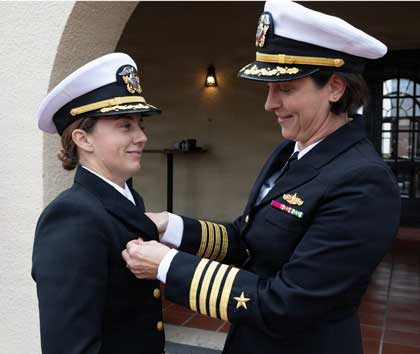
U.S. Navy Captain Sarah Self-Kyler, the commanding officer of Navy Public Affairs Command, pins the command ashore pin onto Cmdr. Jaqueline Pau, the commanding officer of Fleet Public Affairs Center San Diego, during an establishment of command ceremony, Jan. 21, 2026. Fleet Public Affairs Center San Diego provides operational public affairs support to current and emerging public affairs and visual information engagements. U.S. Navy Photo by MC1 Charles J. Scudella III.
Marine Corps announces updated physical fitness standards
by Marine Corps Staff Sgt. Claudia Nix,
Marine Corps Training and Education Command
The Marine Corps is implementing changes to its physical fitness test and body composition standards in accordance with the secretary of war's military fitness standards memorandum issued Sept. 30. These changes, announced in MARADMIN 613/25, will take effect Jan. 1, 2026.
The Marine Corps will institute sex-neutral scoring for the physical fitness test for Marines with a combat arms primary military occupational specialty. The PFT will require those Marines to achieve a minimum score of 210 points, 70% of the total possible points, using the male, age-normed scoring standard outlined in Marine Corps Order 6100.13A.
The PFT will continue to be administered annually, from Jan. 1 to June 30. Noncombat arms Marines will continue to follow existing sex- and age-normed standards.
The new PFT standards reflect the unique physical demands of combat arms roles, ensuring Marines are prepared for the sustained physical performance required in direct combat. Those who do not meet the 210-point requirement by the end of the reporting period will be assigned to remedial physical training and may be subject to reclassification and/or promotion restriction.
"Our combat arms MOSs requires rigorous physical readiness for direct ground combat," said Marine Corps Col. James Derrick, director of the Training Standards Division at the Marine Corp Training and Education Command. "These changes ensure all combat arms Marines meet the same high sex-neutral standards."
The Marine Corps is also revising its body composition evaluation process. The current height and weight standards, along with the tape test, will be replaced by a new waist-to-height ratio method. The Marine Corps will publish service-specific standards upon receipt of additional War Department guidance.
In the interim, the current height/weight and tape tests will continue, with body composition analysis used for additional assessments when necessary.
Although the new PFT standards will begin Jan. 1, 2026, updates to Manpower Information Systems are expected to take six to eight months, with full implementation projected within a year. The Marine Corps is committed to ensuring a smooth transition and will continue to coordinate with stakeholders to support these changes.
Units are required to follow interim administrative guidance until full implementation of system and policy revisions as outlined in MARADMIN 613/25 are complete.
These changes ensure that the Marine Corps' physical fitness standards continue to support operational effectiveness and combat readiness. The Marine Corps will continue to assess guidance and execution to ensure compliance with higher headquarters.
12 military innovations that are now part of everday society
by Katie Lange
Every morning, many of us scour the internet on our phones for a bit before popping some breakfast item into the microwave. Then we head to work using GPS and flip on our sunglasses if it's too bright out.
A lot of us likely didn't realize that all those commonplace conveniences were once innovations developed by or for the military.
In the past century, several inventions created by the War Department for warfighter use have become a part of everyday life for civilians. Below are 12 that you may or may not have known about. Read more...
Miramar Veterinary Clinic offers services for your pets by appointment only
Veterinary Treatment Facility
MCAS Miramar Building 6360
Hours: Mon.-Fri.: 7 a.m. to 3:30 p.m. (858) 307-6552/1773
Open for retail sales (flea and heartworm prevention, oral care) and drug/food prescription refills (if applicable) daily. Routine wellness checkups and vaccinations available, as well as minor sick call. Appointments can be made in person or by phone. Walk-ins aren’t accepted. Dogs and cats of all active duty military members and retirees with medical benefits are eligible to be seen at the facility. The facility always recommends that patrons of the clinic keep their own civilian veterinarian in case of emergency, or if the facility is unable to fulfill their needs.

United Through Reading®
Service members invited to record stories for family
United Through Reading® (UTR) is a free program helping ease the stress of separation for military and veteran families by having the service members or Veteran read children’s books aloud for their family to watch at home during times of physical separation. It is available for any type of separation, including but not limited to, deployment, training, geobaching, or shift work.
UTR provides service members and veterans a chance to make lasting connections from afar through the power of shared storytime. The recording and the book are given to the child and family at home at no cost.
Being a parent is not required; service members can send the recording & book(s) to any special child in their life such as younger sister or brother, niece, nephew, grandchild, or godchild.
The recording can be made via UTR’s free and secure UTR App, at one of UTR’s story stations, or at the Mobile Story Station at a community event. For more information visit unitedthroughreading.org or e-mail military@utr.org